
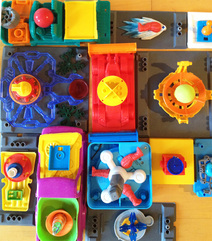
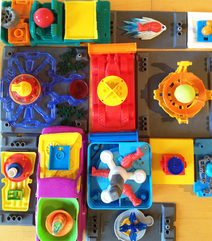
My not-quite-resolved plastic quilty test.
I’ve been left high and dry, marooned by a foul waste stream — a particular category of non-recycled stuff that ends up in Vancouver’s landfill.
This category consists of many boxes of rigid-plastic toy bits that my nephews leave in their wake of play. I nabbed the lot a couple of years back because I loved their indeterminate shapes, their hot colours, their embedded culture. The big plan was to turn these remnants of their childhood into a scrap-quilty, uh, thing. I never really did have a sharp objective for the objects.
But that was before I embarked on my Great Leap Forward Toward More Space campaign in January. Now the toy detritus is the last of my hoardy habit left to face down.
I’ve done the math and have realized that the number of hours required to explore and execute the various art projects that involve all these bits encroaching on my living space probably exceeds my estimated lifespan. But I have another reason for not wanting to part with the toy parts: no one accepts them for recycling in these parts, as dude at the Recycling Hotline (604-732-9253) informed me. All non-numbered rigid plastic junk is just chucked into the landfill where they will stay intact pretty much forever.
This category consists of many boxes of rigid-plastic toy bits that my nephews leave in their wake of play. I nabbed the lot a couple of years back because I loved their indeterminate shapes, their hot colours, their embedded culture. The big plan was to turn these remnants of their childhood into a scrap-quilty, uh, thing. I never really did have a sharp objective for the objects.
But that was before I embarked on my Great Leap Forward Toward More Space campaign in January. Now the toy detritus is the last of my hoardy habit left to face down.
I’ve done the math and have realized that the number of hours required to explore and execute the various art projects that involve all these bits encroaching on my living space probably exceeds my estimated lifespan. But I have another reason for not wanting to part with the toy parts: no one accepts them for recycling in these parts, as dude at the Recycling Hotline (604-732-9253) informed me. All non-numbered rigid plastic junk is just chucked into the landfill where they will stay intact pretty much forever.
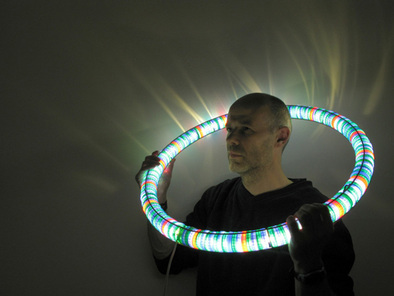
Photo of artist/designer Adrian Draigo from www.draigo.com.
There is another option, he said; I could drive the stuff to a monthly drop-off location in another community set up by Pacific Mobile Depots, pay $7 per big bag to take it all away for use in some plastic-lumber business down the road, or I can pay $30 to arrange a pick-up. It’s a service that is probably used by a tiny minority of households —a tiny drop of effort in the plastic tsunami.
Meanwhile, the quandary is major: Until our governing bodies stop acting like whipping boys to the global petroleum industry and start regulating against the sale of non-recyclable plastic products, we’re all left to either try to make use of the stuff that’s piling up around us or stuff it into the earth.
Many designers have put the glut of a particular waste stream to good use, creating ingenious upcycled products. London-based artist Adrian Draigo, for example, creates lighting using bottle caps — another plastic reject from most recycling programs — and LED lights. The low-energy, ambient ‘Glo’ light can be hung anywhere, literally highlighting the issue of this ubiquitous waste product.
Meanwhile, the quandary is major: Until our governing bodies stop acting like whipping boys to the global petroleum industry and start regulating against the sale of non-recyclable plastic products, we’re all left to either try to make use of the stuff that’s piling up around us or stuff it into the earth.
Many designers have put the glut of a particular waste stream to good use, creating ingenious upcycled products. London-based artist Adrian Draigo, for example, creates lighting using bottle caps — another plastic reject from most recycling programs — and LED lights. The low-energy, ambient ‘Glo’ light can be hung anywhere, literally highlighting the issue of this ubiquitous waste product.
It’s a new spin on the old ‘necessity is the mother of invention’ axiom, except the need that drives this innovation is not in the resulting use-object but in reducing garbage. The key to this — and every —upcycling project is creating an object that people want, otherwise it’s just waste transformed.
My urge to use the throwaways falls more within the need to visually express short-sighted (at best) and greed-driven (more likely) global production-consumption actions. The motivation to make my scrappy sculpture starts from medium and works toward idea rather than the other way around. This compulsion to dream up an idea in order to make use of the bits feels overly opportunistic, and it’s why I remain in option-paralysis over whether to keep it to maybe one day use it or let it all go. That’s what happens when you’re confronted by this plastic problem.
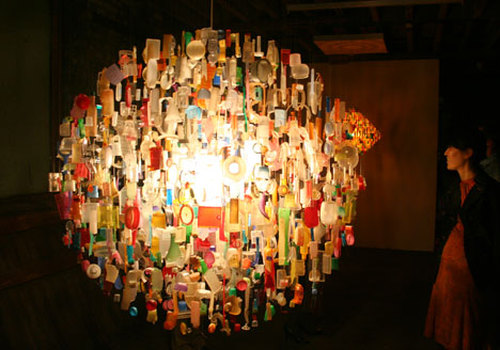
photo from www.core77.com
UK artist Stuart Haygarth made good use of what showed up in his environment with his iconic “Tide” chandelier. The suspended sphere is fabricated from the plastic that washed up on a particular stretch of the Kent coastline.
The work makes it impossible not to think of the giant garbage patches swirling around the planet.
For more on that staggering reality, hit this Ted Talk:
Recent Comments