
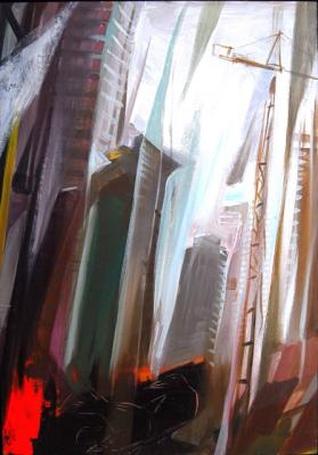
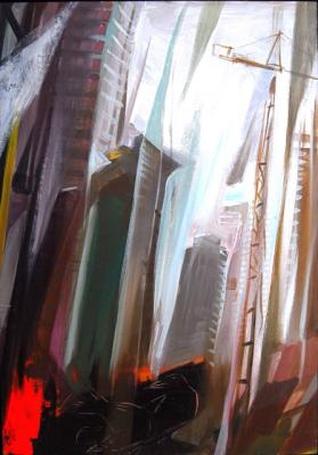
 Urban Crow (detail), by Richard Tetrault
I have this vague, hippie-era-soaked memory
of my brother and I hanging with my father as he painted a wall alongside some other artists. Forty years later I suggested to my brother that he swing by my own mural project last summer, reminding him of those times when we were to come see the art in the making.There’s a humble history of mural-making in East Vancouver, but well-known Strathcona-based artist Richard Tetrault has taken it to new heights. Speaking in Vancouver and Richmond this week, his survey of his large-scale, collaborative, very public paintings emphasizes place and history.
His work is about layers: the often conflicting layers of histories of Vancouver’s distinct communities and the layers of translucent colour that identify his painting style.
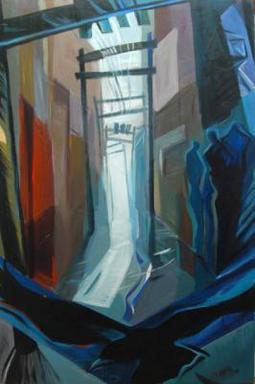 Iconic hydro poles and back lanes, Urban Crow (detail)
Then there is the challenge of the logistics of securing funding and handling swing stages and working while exposed to the elements. These are skills that only develop from a lifetime of experience in public mural-making, and are invisible in his slideshow of works that show, say, collaborating members of the Chinese, First Nations, and Japanese community represented in the Radius mural at the Firehall Theatre in Vancouver’s Downtown Eastside (below).
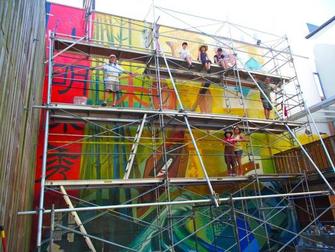 The Radius mural in progress at the Firehall Theatre.
Tetrault is heavily influenced by his own early-adult years in Mexico, absorbing the social art murals by the likes of the big three — Orozco, Rivera, and Siqueiros — whose large-scale public artworks were created to speak to a largely illiterate indigenous population.
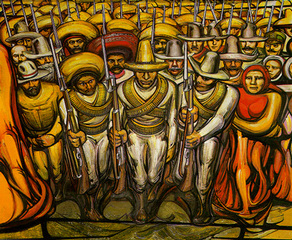 Siqueiros’ Revolutionaries (detail), 1957-65
Is a mural without a message — such as to remember a history of struggle, to give rights or hope to the wronged, to call to action — mere decoration? Is colour, beauty and skill worthy enough of public funding? What are the parameters for officially sanctioning one kind of expression over another? Should the public have input into what is being funded?
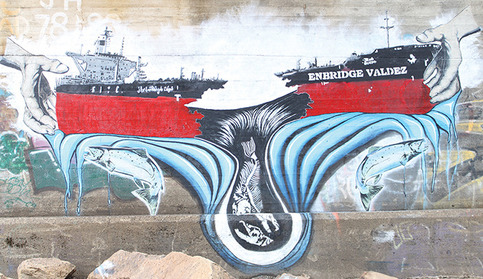 One Terrace local shares his views on the Enbridge campaign. Photo by Josh Massey
It can be seen in the work of my cousin in Terrace BC. (name withheld) for his anti-Enbridge art on the public property of the old Skeena Bridge and possibly painted out by now. For the people, by the people.
***
Richard Tetrault’s murals can be seen in the flesh with the help of the interactive maps in this self-guided Eastside Mural Tour.
Recent Comments