

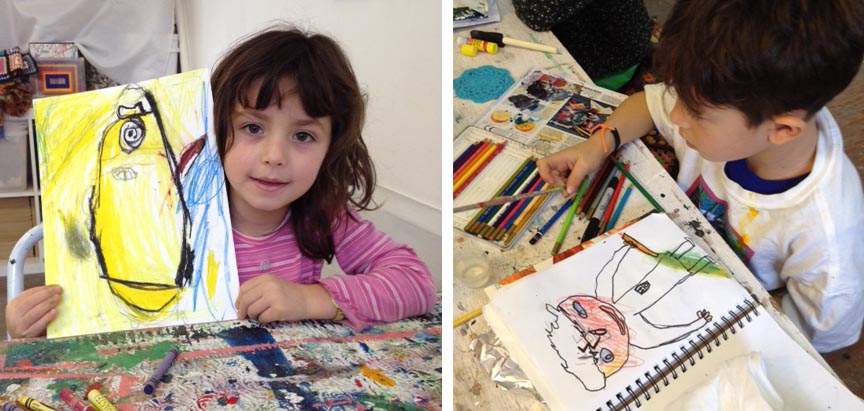
There is nothing easy about mixing wildly enthusiastic kids with acrylic paint and ink, Sharpies, white glue, pointy scissors and a wide range of making materials. But through trial and error, this messy, slightly chaotic exploratory play leads to some beautiful surprises.
Kids at this age are not hung up on outcomes yet; they are intrinsically curious about whatever materials they come across. Their gift is showing me where their untamed hearts take them, without wrecking the joint.
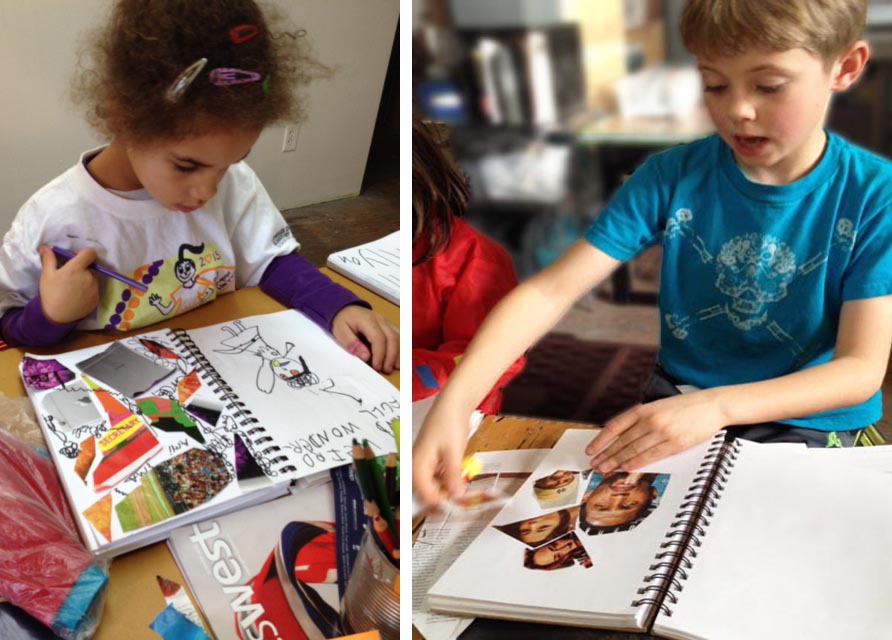
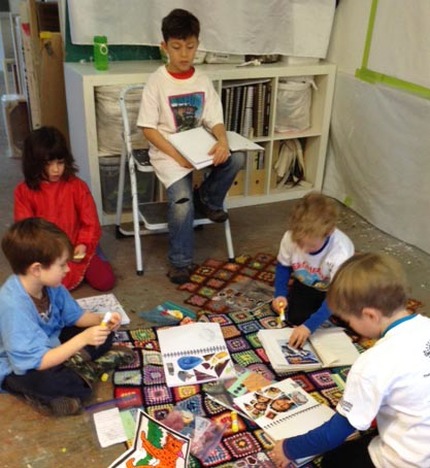 Kids start the session by adding bits from their world to their sketchbooks.
I started by giving each kid a coil-bound sketchbook that would live in the studio for the entire six weeks. This is where all the weekly experiments would go, but it would also be a place for them to glue in any flat things they collected that week from their world — photos, leaves, magazine clippings, bits of fabric, birthday cards.
The sketchbook “stuffing” quickly became the warm-up to art-making, as kids ran into the studio to retrieve their sketchbook from the shelf, showing one another their latest finds, and looking over their past pages.
As they stuffed they discovered new ways to arrange the pieces, which often led to new ideas. For example, one page of glued coins and leaves became a story about a money tree. Another kid learned how to do pencil rubbings on the reverse side of his page of found objects.
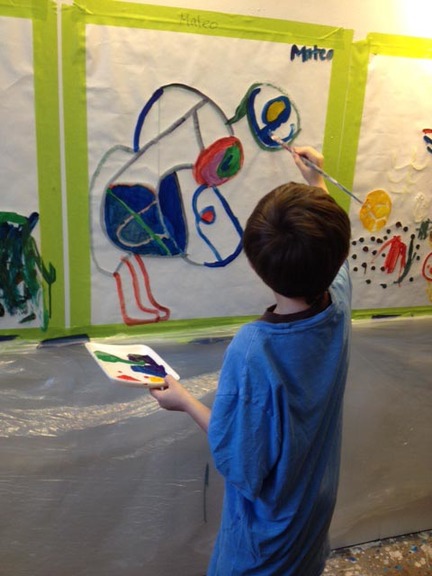 A suggestion of painting what’s on the inside of our bodies and mind had some surprising exploratory results.
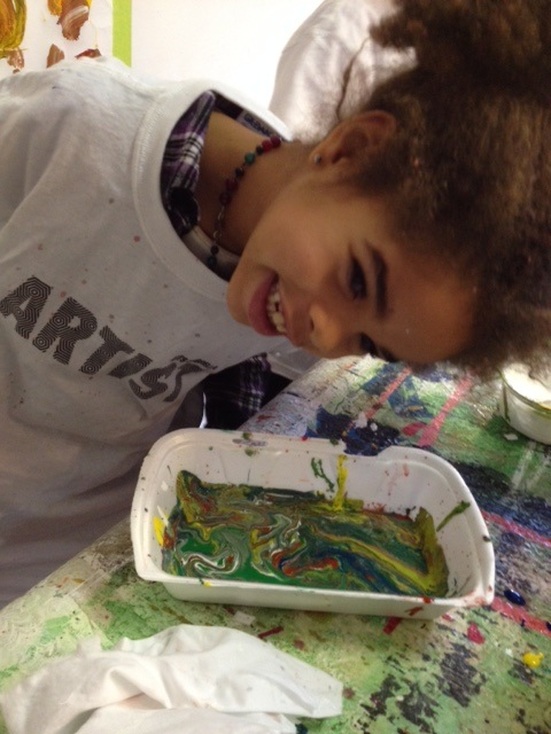
I remember being frustrated over the limitations of gritty, porridge-like tempera paints, unyielding plastic paint brushes and shabby newsprint so I put out a bucket stuffed with quality brushes of all sizes and a selection of brilliant, heavy-body acrylic paints. I set them up with their own Styrofoam palettes, a large sheet of white paper masked out right on the wall and made the intentionally vague suggestion that they paint what is inside them. That led to some surprising abstracts, and yes, it did include one portrait of poo. But it was poo with great intention, plus the kid who did that ended up captivated by his palette of swirling colours so the next Saturday he cut it out and glued it into his sketchbook.
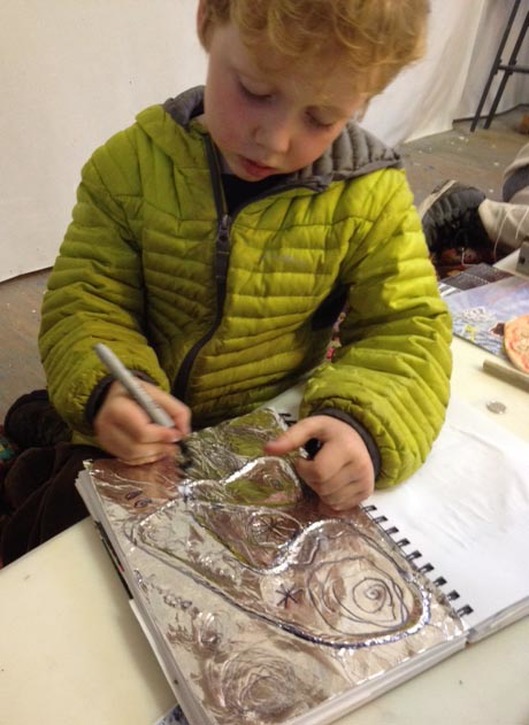
At right: A bit of yarn, some glue and a sheet of tinfoil transported this young artist into a world of tornadoes and skateboards (or was that snowboards?).
Every week we talked about the word, ‘inspired’, as in, I am inspired by your great works.