Hand-making outside the dominant economic system
The news is inescapable. The Trump tariffs announced last week will “rupture the global economy,” warns the Prime Minister. This is on top of the inflationary wallop on 45 per cent of Canadians who reported that rising prices were “greatly affecting their ability to meet day-to-day expenses in the spring of 2024, up 12 percentage points from two years earlier,” according to Statistics Canada. Further, almost one-third of Canadians are “experiencing financial difficulties,” up from 18.6 per cent in 2021. It’s all led to a “gradual deterioration in life satisfaction” especially among younger adults and those with financial difficulties. On top of all this, Canada is in the throes of a snap federal election.
Yet life goes on. That robin outside my window is still doing its 4 a.m. wake-up call. The cherry tree it perches on is about to burst into pink snowballs. Below the tree canopy the Amazon vans still roar through the neighbourhood and the UberEats drivers still double-park to keep up with their orders.
Maybe, and I’m just spit-balling here, we can be like the blossoms and flourish independent of the consumer economy and the attention economy, that battleground that has us in a near permanent state of distraction. I searched how reverse life dissatisfaction and received this AI Overview:
“To reverse life dissatisfaction, focus on identifying the root causes, setting realistic goals, practicing self-care, engaging in meaningful activities, and seeking support when needed.”
Even this banal Google-bot response on the general theme of self-reflection begins with the word ‘focus’, followed by ‘practicing’, ‘engaging’, ‘meaningful’, ‘activities’, ‘seeking’ and ‘support’ — words in direct opposition to ‘distraction’, ‘escaping’, ‘frivolous’, ‘inertia’, ‘ignoring’ and ‘undermine.’ There are no Tips and Tricks in the AI Overview for reversing life dissatisfaction through retail therapy, no easy instructions to move fast and break things, or buy bit-coin, self-medicate, move somewhere else or to hang on tight to your privilege.
The beautiful thing about having a number of ongoing art projects is that there’s always one that fits the moment. Right now that’s Hearth.
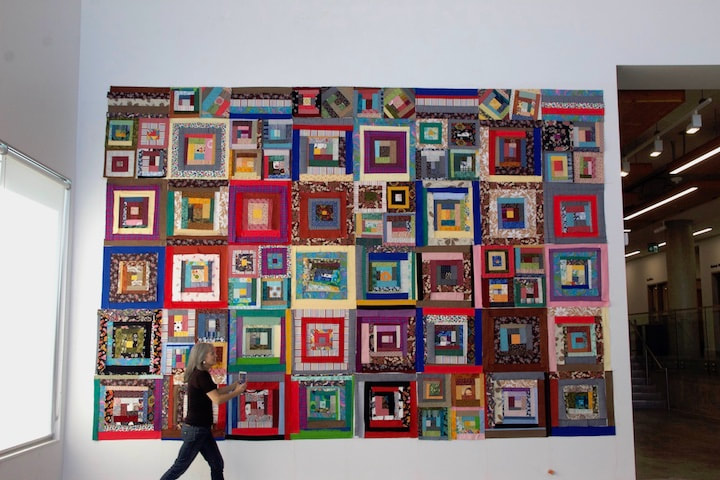
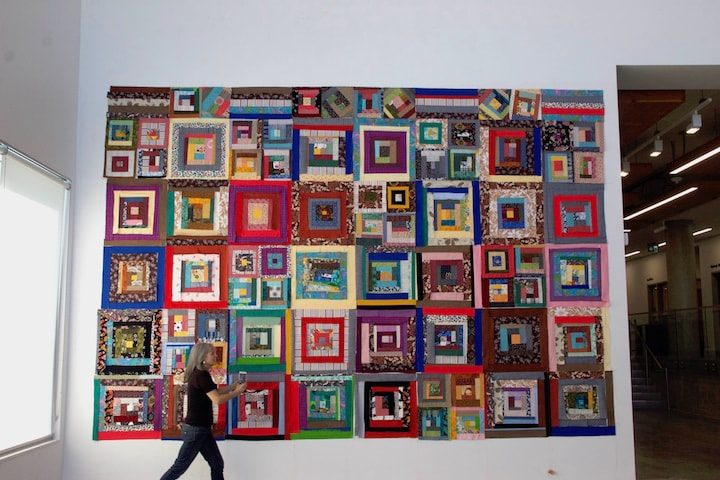
Social making sessions resulted in this first installation of ‘Hearth.’ (Carlyn Yandle)
Started back in the beforetimes of 2019, Hearth is an infinitely-expanding grid of log-cabin quilt blocks that began with an idea: What kind of art-making would be engaging and easy enough to attract a diverse population, a big-picture zero-waste project that would cost nothing? What could create the chance to learn a new skill, meet people beyond one’s usual social circle, that would include the joys of giving and receiving, all toward a gallery exhibition?
Over the next six months, dozens of friends and friends-of-friends, neighbours, colleagues and people just happening by gathered at art studios, porches, around kitchen tables and living rooms. In groups from two to a dozen, we hand-stitched log-cabin-style quilt blocks from strips of donated fabric in improvised spirals around a central (“hearth”) square.
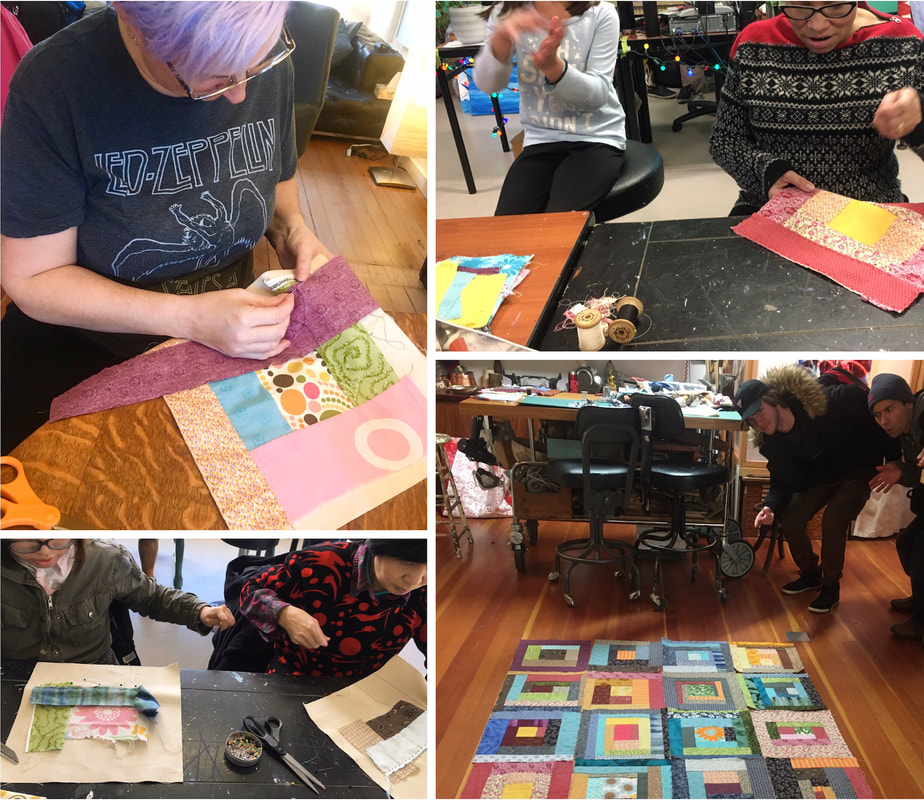
Some early stitching sessions (Carlyn Yandle photos)
The blocks were eventually all installed into a massive wall installation as part of my MFA thesis exactly one day before the university shut its doors for several months. We didn’t give up our will; we organized contact-free fabric swaps and took the project online, sharing ideas and stitching instead of drinking.
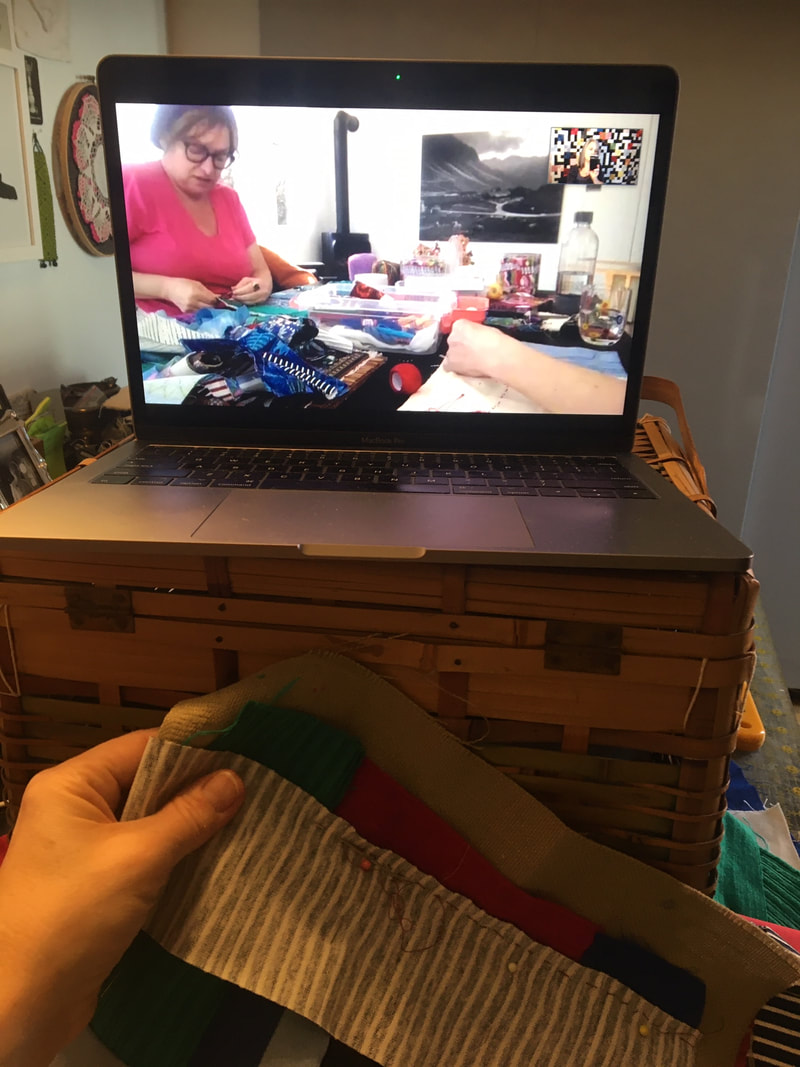
Socializing at a distance: a Zoom stitching session (Carlyn Yandle)
When the lockdown rules relaxed, Hearth was instrumental in rekindling social activity. Any in-person awkwardness dissipated as we focused on hand-stitching or just dug through the heap of fabric strips to create a pleasing palette, for our own blocks or to offer someone else.
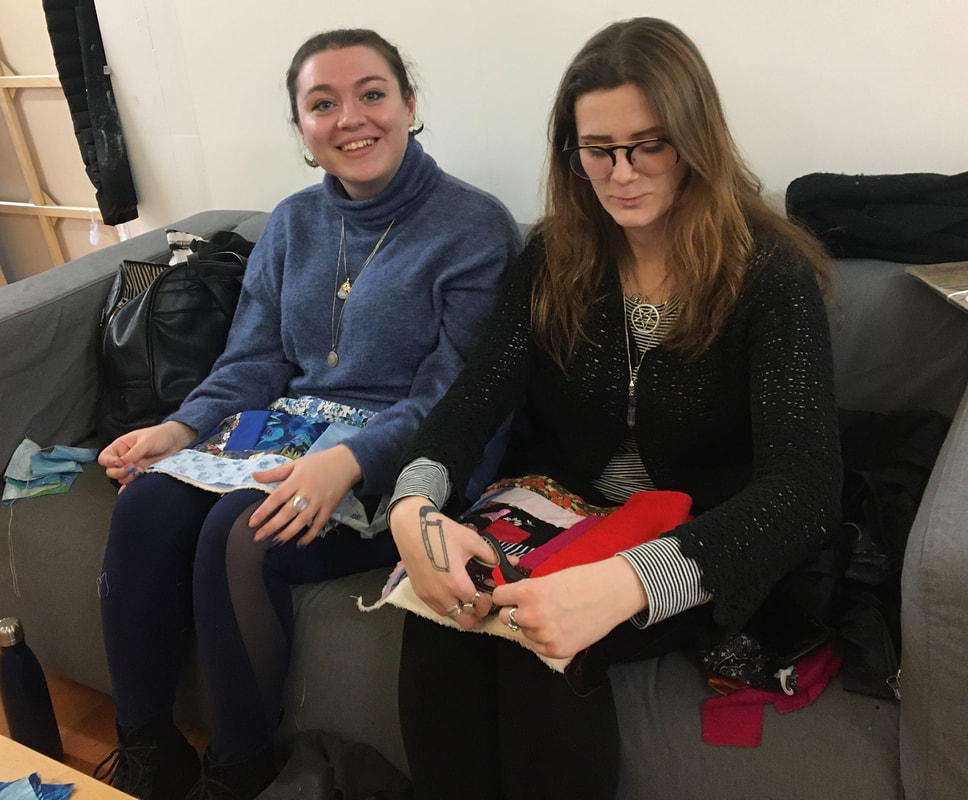
RE-START: An early post-lockdown session with MFA colleagues
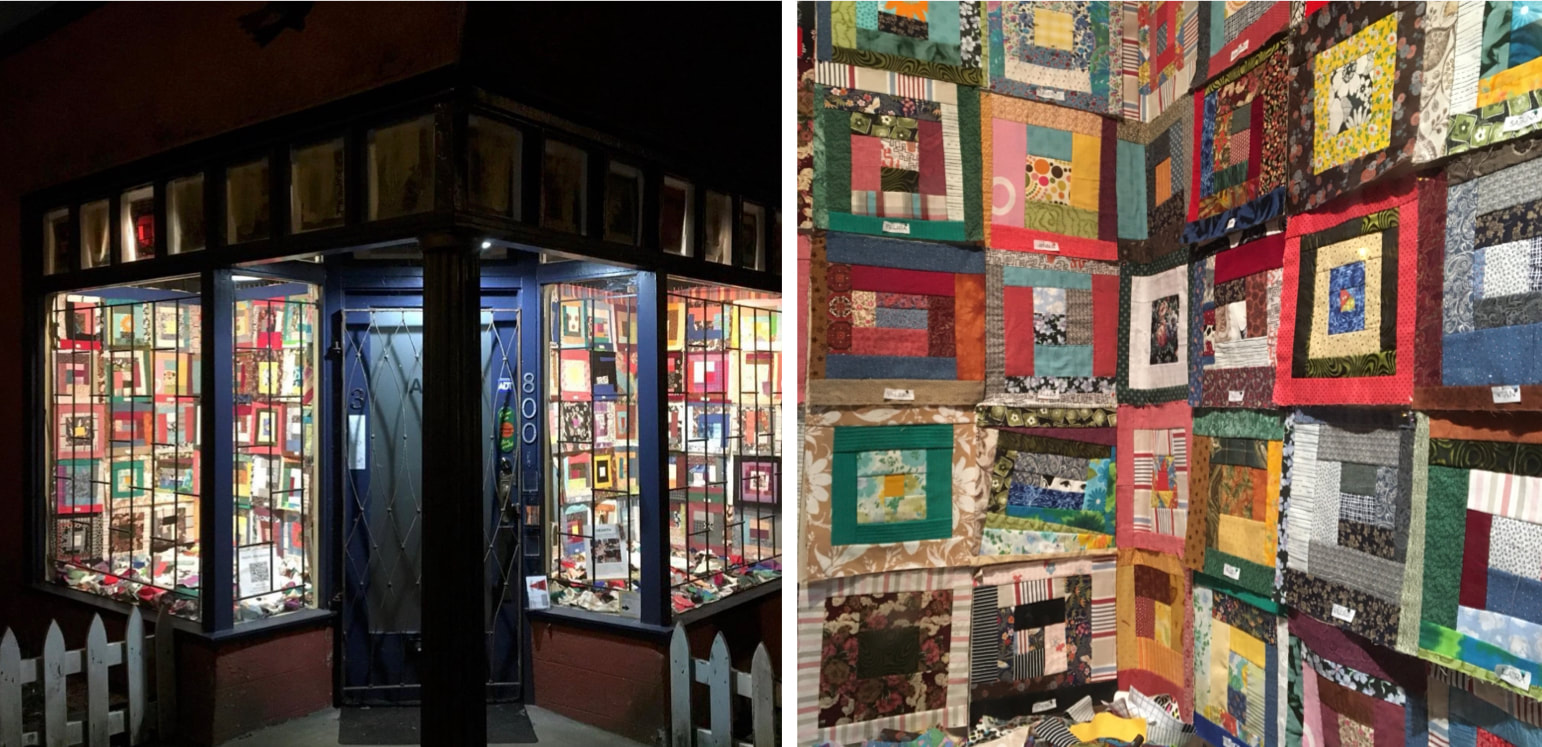
A street-front gallery show in the early post-pandemic; interior detail
It takes about two hours for anyone who can hold a needle to stitch a block, about the same time as any social visit. The makers, many of whom learned that in fact they could sew a straight line, were free to take their finished piece home, maybe to use as a cushion cover, placemat or the beginning of a quilt top. Most contributed their blocks to the Hearth project so their own handwork would be a part of a gallery show, with due credit.
As normal daily activity resumed, I moved the one bin of fabric strips and the other of finished blocks into deep storage. But just as sure as that cherry tree outside my window will burst into bloom, that project is coming back out for a show of its own. It’s a new chance to focus on practicing engaging, meaningful activity designed for those seeking connection and support outside this dominant, volatile economic system, away from forces screaming for our attention. In these perilous times we’re creating something bigger than our individual selves, one stitch, one block at a time.

Recent Comments