
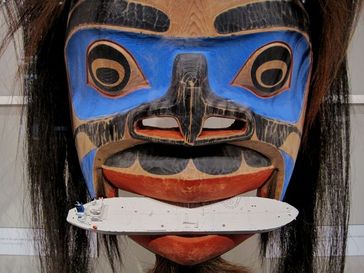
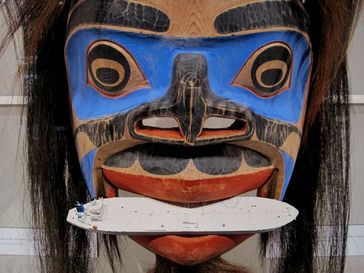
 Yagis Eating an Oil Tanker by Ian Reid Nusi. (Photo by Christopher Glawe)
Marshall McLuhan said, “Art at its most significant is a Distant Early Warning System that can always be relied on to tell the old culture what is beginning to happen to it.” And that’s what I think about when I see this work by Ian Reid Nusi. Yup, that would be an oil tanker in that sea monster’s mouth, carved in response to the prospect of the Northern Gateway oil pipeline moving tar sands diluted bitumen to the coast and onto tankers. (Artist interview clip below)
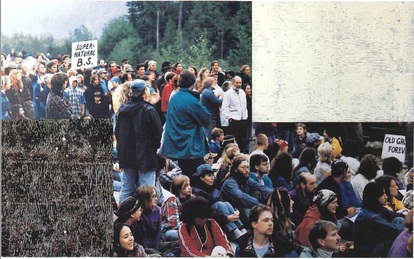 Wallace’s CP IV, 1993-95, 178 x 300 cm (from Canadian Art magazine)
His plywood patterns interrupt the protest images from the summer of 1993, the height of the fight to save Clayoquot Sound, the largest unlogged temperate rainforest on Vancouver Island. About 800 protestors were arrested and carted away, while Wallace created a whole new way of seeing art, protest and the role and position of the visual artist.
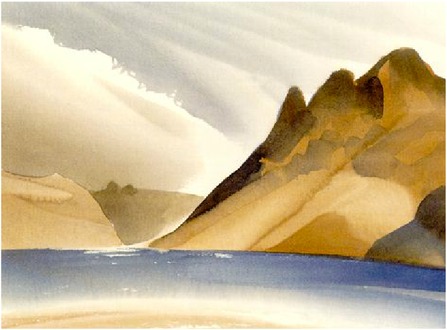 Headwaters of the Stein, B.C., August 1988 (from tonionley.com)
Onley, who died in 2004, recalled painting a watercolour in support of a Stein cultural centre while “Chief Perry Redon, the chairman of the Lilloet Tribal Council… beat his drum and sang to the four quarters. I was inspired and soon we had a watercolour for the Stein poster….”
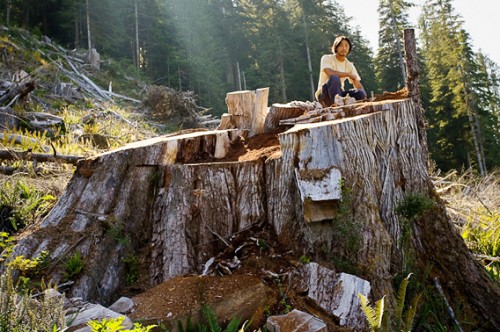 Ken Wu photo by T.J. Watt (tjwatt.com)
But there’s nothing like a compelling photograph to bring the stark reality of the protest home.
T.J. Watt’s photo of Ken Wu, the Ancient Forest Alliance’s executive director, sits atop a massive red cedar stump in the Upper Walbran Valley on Vancouver Island. The photo earns its place as an important visual of the struggle to retain a small portion of the natural environment, but its place is also determined by this image that is forceful in its subject of scale and a unique moment in time.
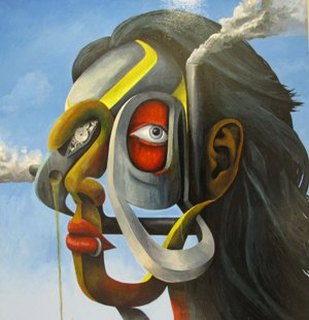 Shawn Hunt’s Untitled, 2013
It’s there on the faces of the growing protestors, and in the art that’s growing along with it. And sometimes, as in this surrealist portrait by Shawn Hunt, it’s in the faces in the art.
This is the history of environmental struggle in this corner of the world, and part of the history of art, too.
Recent Comments