
I’ve learned to live with a head full of bees but these days it’s all about wasps.
So. Many. Wasps. Wasps that retreated indoors last week after the pest-control guy shot up the kitchen fan vent with a killer powder. Wasps that just wouldn’t stay away even after two pest-control guys came back to deal with the discovery of an impressive-sized nest metastasizing inside the wall. I spent most of the week whacking at wasps and sucking them up in the hand-held vacuum cleaner. Whacking and sucking, whacking and sucking.
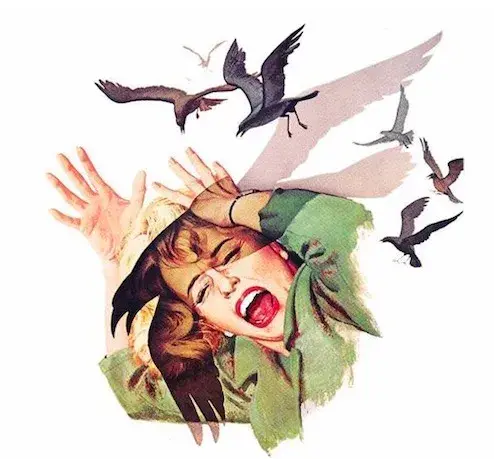
It’s not the sight of a single curled-up carcass that gives me the willies; it’s the sheer volume of them. A ladybug on my forearm might prompt that little rhyme, Ladybug, ladybug, fly away home / Your house is on fire, your children are burned… Wait, what is that all about? My point is, if a cloud of ladybugs landed on my arm I would be screaming like Tippi Hedren in The Birds. Hitchcock knew all about the power of numbers to turn bird-friendly movie-goers into ornithophobes.
So. Many. Wasps. Wasps that retreated indoors last week after the pest-control guy shot up the kitchen fan vent with a killer powder. Wasps that just wouldn’t stay away even after two pest-control guys came back to deal with the discovery of an impressive-sized nest metastasizing inside the wall. I spent most of the week whacking at wasps and sucking them up in the hand-held vacuum cleaner. Whacking and sucking, whacking and sucking.
It’s not the sight of a single curled-up carcass that gives me the willies; it’s the sheer volume of them. A ladybug on my forearm might prompt that little rhyme, Ladybug, ladybug, fly away home / Your house is on fire, your children are burned… Wait, what is that all about? My point is, if a cloud of ladybugs landed on my arm I would be screaming like Tippi Hedren in The Birds. Hitchcock knew all about the power of numbers to turn bird-friendly movie-goers into ornithophobes.
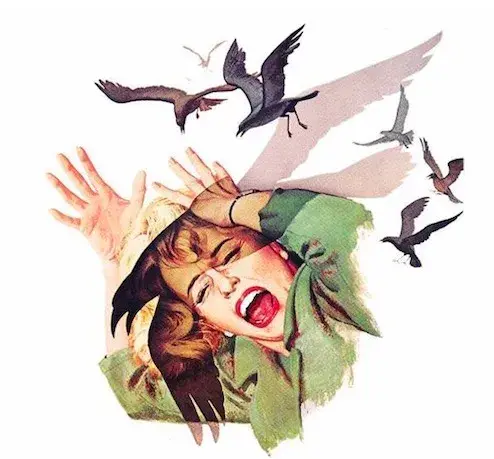
Poster art from the 1963 Hitchcock classic, “The Birds.”
A large mass of harmless insects doesn’t even need to touch me to get my skin crawling, like the summer when I watched my mother slap at a few flying ants on the window with her fly-swatter while behind her a black mass of hatchlings oozed out of a wood ceiling beam and swarmed the room. Even writing about that overabundance gives me the heebie-jeebies.
Large accumulations of a single object — animate or inanimate — cranks up the visual volume. Canadian artist-photographer Edward Burtynsky introduced viewers to the extreme-scale reality of global trade in Manufactured Landscapes from the first scene of some sewers bent over their machines in the Hongqingting Shoe Factory, Wenzhou, Zhejiang Province, China. There is no commentary as the camera slow-pans down the length of what emerges as a stadium-sized building full of several hundred workers, allowing us to fully grasp the enormity of this production. (And that was 20 years ago.)
Large accumulations of a single object — animate or inanimate — cranks up the visual volume. Canadian artist-photographer Edward Burtynsky introduced viewers to the extreme-scale reality of global trade in Manufactured Landscapes from the first scene of some sewers bent over their machines in the Hongqingting Shoe Factory, Wenzhou, Zhejiang Province, China. There is no commentary as the camera slow-pans down the length of what emerges as a stadium-sized building full of several hundred workers, allowing us to fully grasp the enormity of this production. (And that was 20 years ago.)
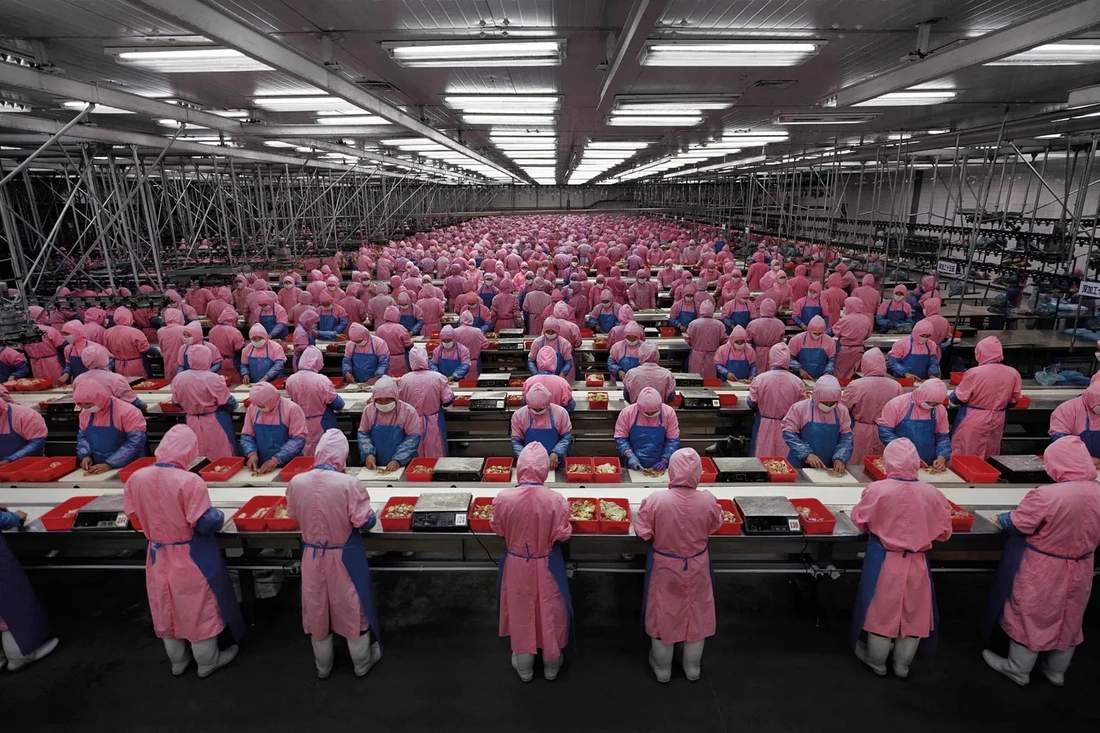
Edward Burtynsky’s large-format photograph, Manufacturing #17, Deda Chicken Processing Plant, Dehui City, Jilin Province, China, 2005 via Public Delivery (https://publicdelivery.org/edward-burtynsky-china/)
But the power of increased scale, accumulation of objects and repetition of patterns isn’t always in service for horror; how or when to use that power comes into question whenever I’m developing new work. Is more more here? Or does repeating the unit or method dilute its essence, reducing the overall work to an underwhelming pattern? More importantly, is my interest in pumping up the volume in art just hoarding?
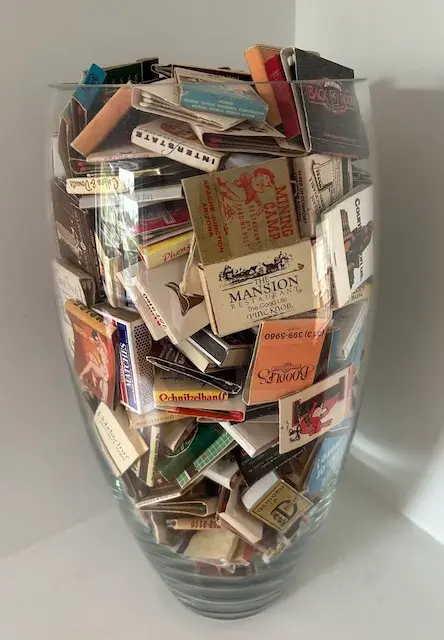
An accumulation of matchbooks is just a collection.
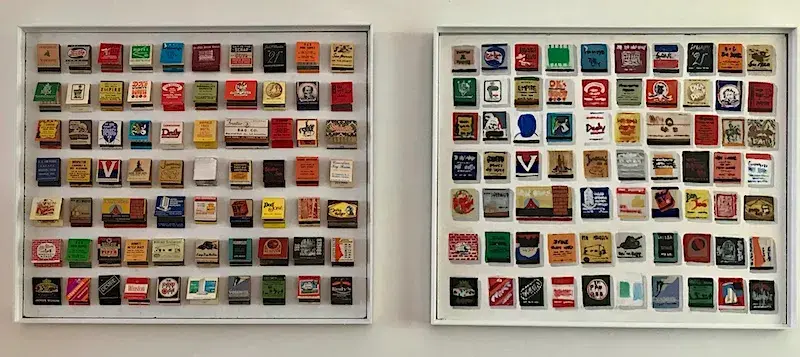
“Matchy Matchy”, an atypical presentation of an accumulation of matchbooks (left) and a three-hour painting-sketch of that collection (right). (Carlyn Yandle)
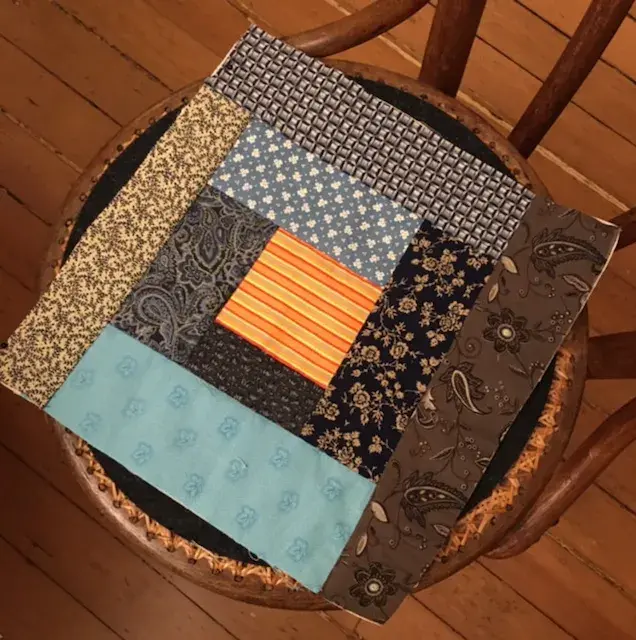
A benign single ‘log cabin’ hand-stitched quilt block.
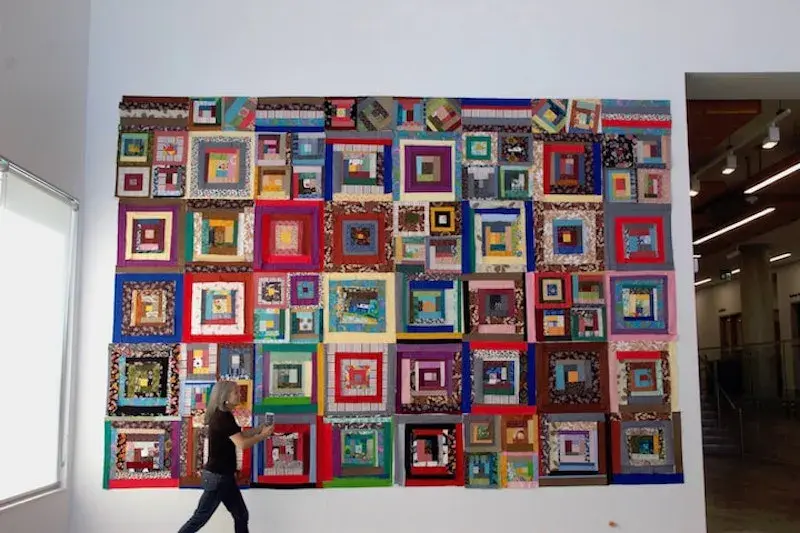
The growth potential of “Hearth” (2020), hand-stitched log-cabin quilt blocks of different sizes, is limitless. (Carlyn Yandle)
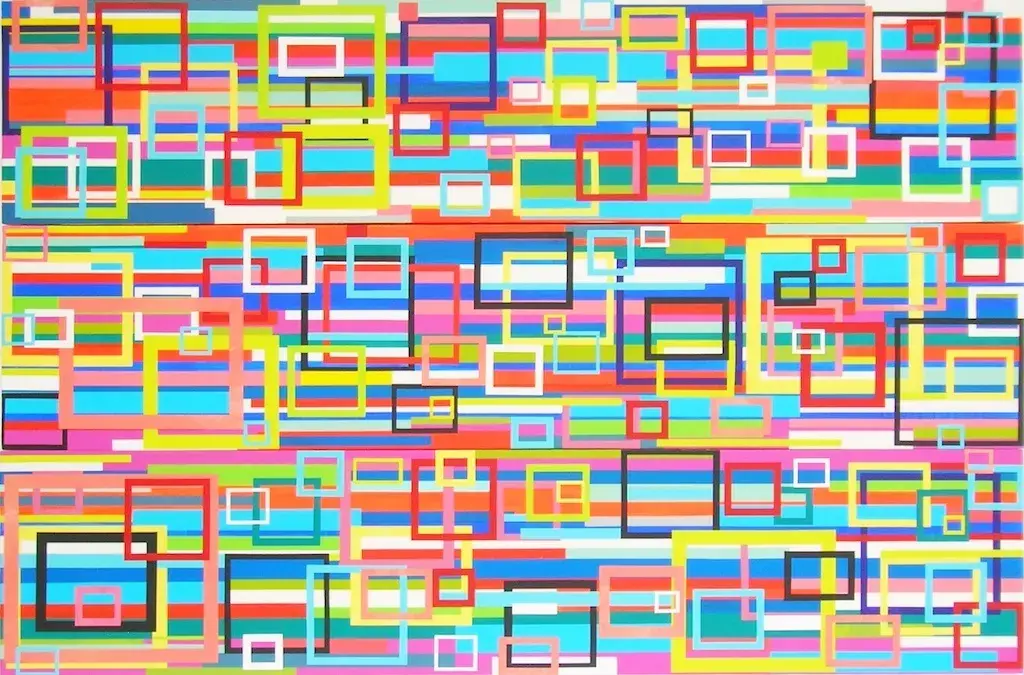
When more is more: A large scale painting of an overabundance of layered squares aims to overwhelm in “PopUp: Triptych,” 2010, acrylic on panel, 96”Wx48”H
These are the busy-busy bees’ questions that mostly come at night when the wasps have gone to sleep, resting up to torment me another day.
Recent Comments