
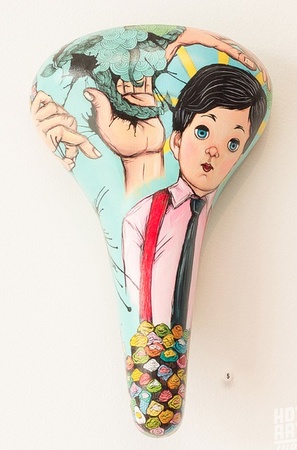
Dotted with bike seats donated by Our Community Bikes and Pedal Depot, the little white room served up wedges of unbridled creativity of local artists, in this twisted take on a show of paintings and mixed media.
|
Moving common objects into the rarified position of a ground for artistic expression creates something that’s more than the sum of its parts — not just a painting, not just a thing. The creative effort and skill in the painting is heightened by the fact that it is relegated to a utility item, while the thing transcends its intended use to serve up a new reading, an altered understanding, a line of questioning: Why the bike seats? Why the subject matter? Is the theme simply an art of opportunity, a result of an over-abundance of available objects? Is it an intentional reflection on a cycle-manic city rich in unconventional creatives? Or is the germ of the idea a refusal to conform to painting conventions?
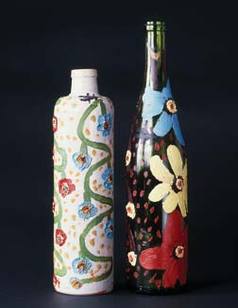
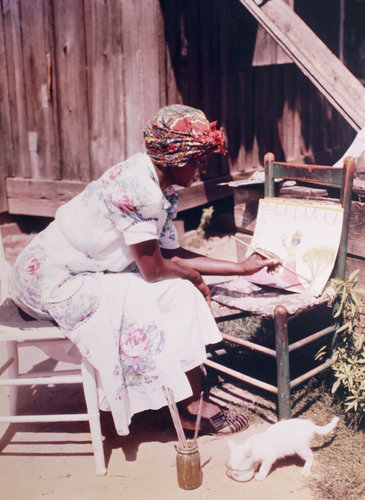
I love that buzzy experience of vacillating between viewing the painting-object as a thing and an idea. My brain was a-buzz again while reading a New York Times travel feature on Clementine Hunter, a well-known New Orleans artist who was born on a cotton plantation in the 1880s. |
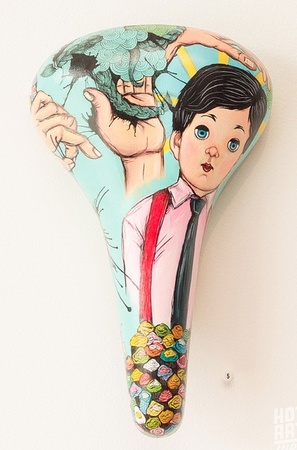
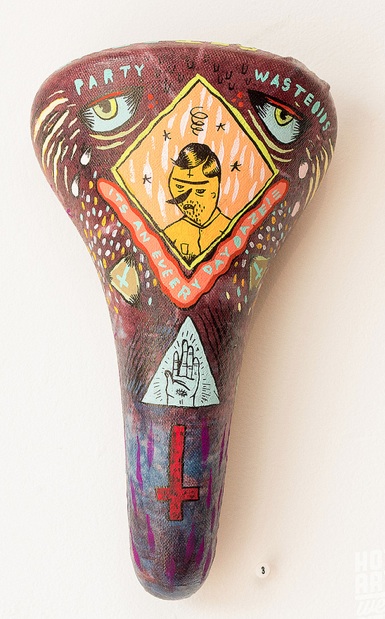
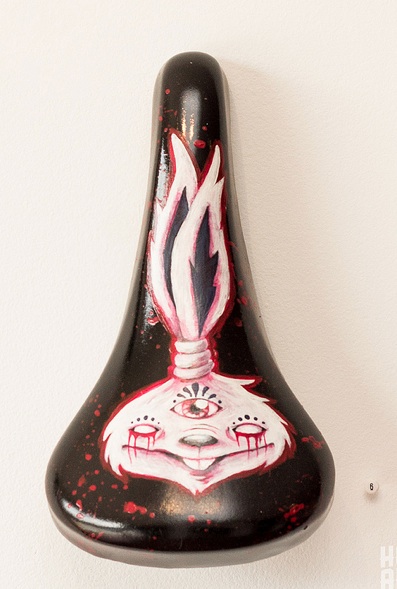
Vancouver artist Andrea Hooges‘ signature narratives transforms a common bike seat. Below: works by Brandon Cotter (left) and Jenn Brisson (right). All photos by Chris Bentzen
|
|
|
|
Crossing that traditional boundary between two-dimensional and three-dimensional work can read as an act of creative defiance, especially when the painting is at odds with the object that serves as its ground. It pushes at sensibilities, it disarms.
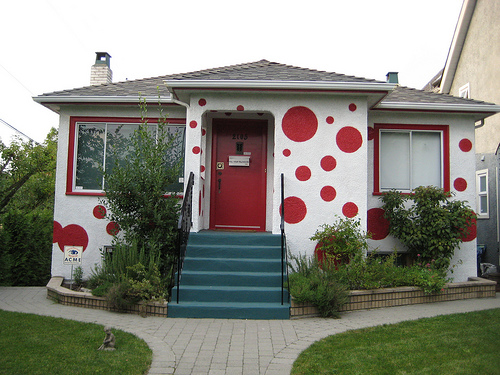
And it can charm. The Polka Dot House, as it is affectionately known in its East Van neighbourhood, was painted in 1992 by owner (and White Spot executive chef) Chuck Currie. (Veteran city writer Eva Lazarus’s piece on the Polka Dot House here.) Only through the use of the dwelling-object as painting ground can polka dots hold the power to poke at community sensibilities. |
|
Recent Comments