
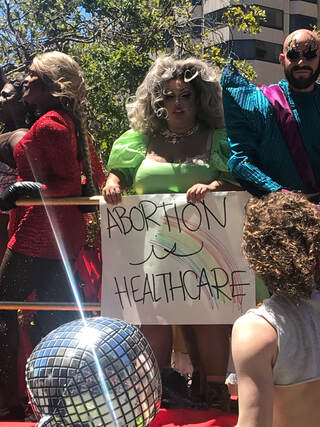
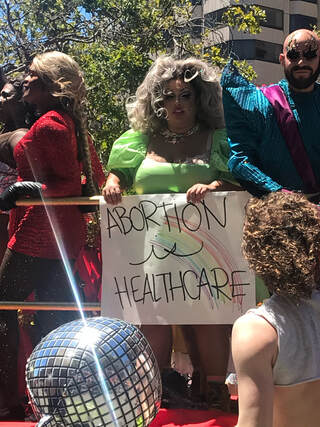
 San Francisco Pride float, 2022 (Carlyn Yandle photo)
By the time the Dykes on Bikes marshalled in the rest of raucous procession the celebration had morphed into a colourful protest. Democrat House speaker Nancy Pelosi was perched on a red convertible, smiling and waving to the cheering crowd just 18 months after her life-threatening ordeal at the Capitol (and less than six months before her husband would be bludgeoned in a politically-motivated home-invasion). That’s some chutzpah, even with her hefty security detail and tank-like SUV with blacked-out windows following close behind.
She may have led the Pride news coverage that night but to me the most potent part of that parade was the hasty cardboard signs. The scrawled messaging radiated with the heat of that moment and the passion that fuelled some riled-up people to come together for an immediate mark-making response.
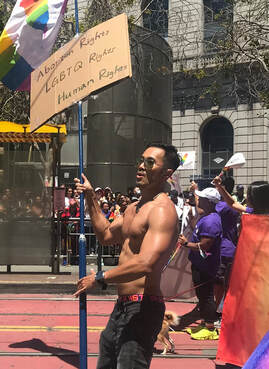 (Carlyn Yandle photo)
The opposite of this experience was the nascent Puerto Vallarta parade of 2017, a sparse but sparkly procession of sexy cowboys, drag Virgens de Guadaloupe and piñatas in the likeness of Trump with a gaping hole where his tiny mouth should be. I love the notion of traditional piñata-makers paper-maché-ing the bulbous bodies and cutting Velveta-coloured paper hair fringes to make the Trumpiñatas. The intensity of that parade was in all those non-commercial, handmade costumes and flatbed floats, at a time and place where flying your true colours is not only gutsy, but dangerous.
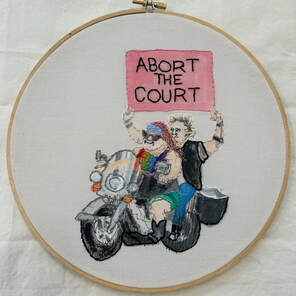
How to harness that drive to make without fear that it’s not good enough or that it’s too didactic or that it will inflame the trolls — this is my challenge. My sweetie, a career political cartoonist, also wrestles with getting it right, worried that all the cross-hatching and caricature honed over a lifetime won’t stand up to a particular idea, or that the idea won’t resonate with readers so doesn’t warrant the mark-making. Those adult worries are fun-killers.
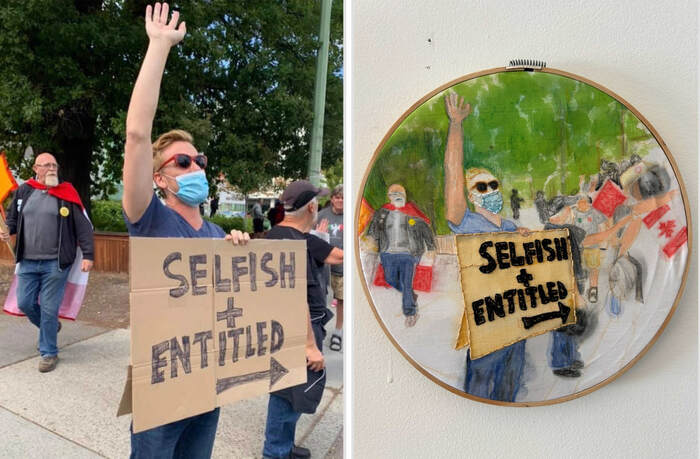
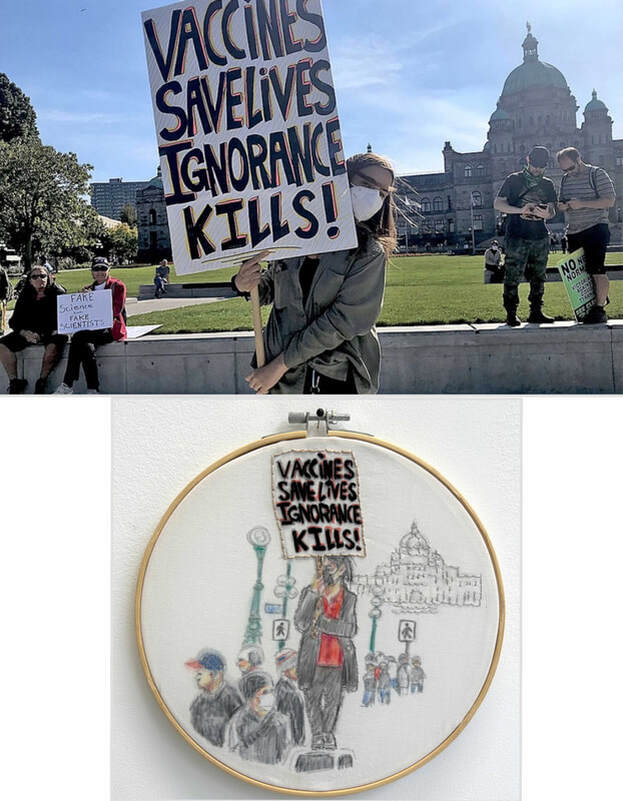
But the San Francisco Pride parade dislodged something and we decided to go all in, which since then has become a series of his drawings, my stitching, our painting on linen, with the news item for context printed around the edge of the embroidery hoop that holds it all together. These are Points of Interest, a blend of journalism and craftivism, a series of tangible historical documents in a virtual world. They are not decor-pretty but function as a virtual archive of hand-rendered images and text, shared digitally for the purpose of community engagement and further exploration into personal and political creative processes.
We may not ever get back in the fold of newspaper journalism but we’re having some fun riding that vehicle for social change through photography, drawing, painting, stitching, writing and sharing on our socials, without fear or favour.
Below: Other social activism that have inspired acts of craftivism:
Recent Comments