
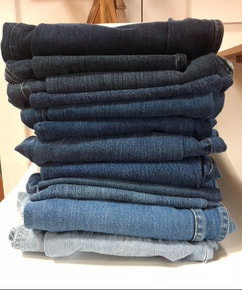
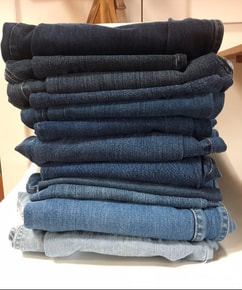
It poisons waterways, mainly in China, prompting environmental groups to raise the alarm against the devastation to communities and local ecosystems, yet consumers around the world continue to cycle through jeans, for work and in slavish loyalty to fashion trends.
Even on the small off-the-grid Gulf island of Lasqueti where I do much of my work, there is a constant oversupply of denim at the local Free Store. Too ugly or thrashed to be snapped up for the price of zero, they are destined for the landfill where the toxic dyes are left to leach into the ground.
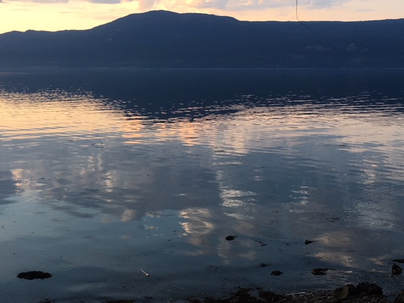 Jeans reflect the West Coast palette. Carlyn Yandle photo
For the past few years I’ve been cutting them into usable pieces and sewing up utility items — bags, oven mitts, hot-pot mats, lumbar cushions — and before long I fell into my own tiny cottage industry stitching up utility aprons.
Lately I’ve been working them up in quilts of high-contrast hues with frayed exposed seams or muted reverse greys, all in conversation with the coastal views just beyond my sewing table.


I dabbled with undulating appliquéd fields inspired by the coastal climate and vistas but lately I’ve been more interested in exploiting the sculptural possibilities of this weighty, stiff fabric.
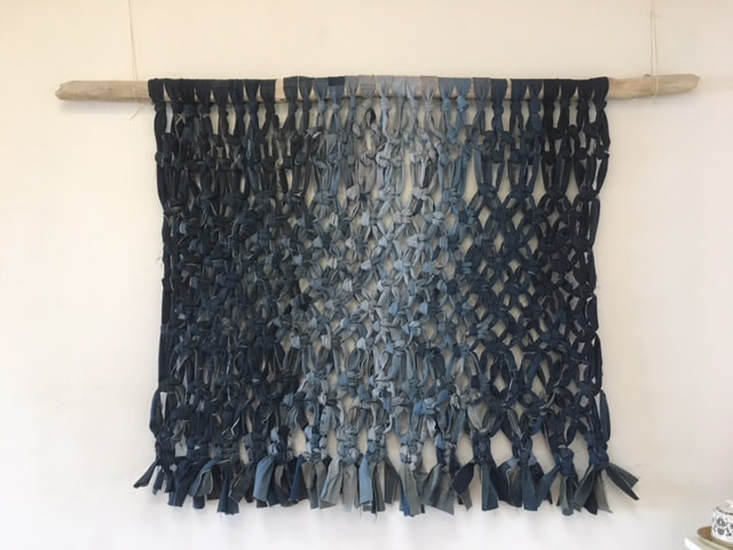
Enter my latest exploration: large-scale macrame.


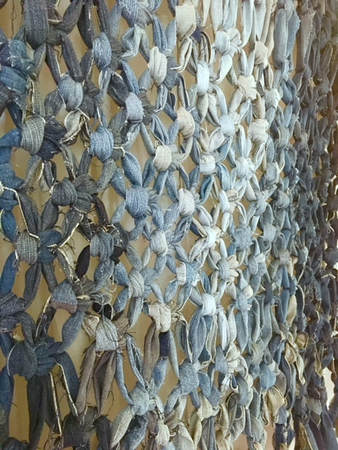
I gave myself some rules of engagement (like I do) to create a pattern. 1) The strands would be all three-inch strips. 2) The overall length would be largely determined by the number of strips I could squeeze out of an average size of jeans. 3) I would work from dark jeans to light to dark fabrics, to create a highlight in the centre of the piece. 4) The overall width of this super-fringe would be determined by the piece of driftwood I selected.
Fifty-five hours of knotty work later I completed 28 Jeans: Denim Ombré, a wall-mounted macrame work that continues to inspire more ideas and more questions: How can I achieve a more sculptural effect? How can I find that beautiful place between pattern and collapse? And most importantly: Why did I throw away my old macrame magazines??
Recent Comments