
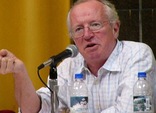
I do so love a shit-disturber, whether it’s fearless Middle-East reporter/author Robert Fisk ripping apart mainstream media last Saturday night downtown or the venerable art critic Jan Verwoert at UBC Wednesday night, talking about “irreconcilable ape-shittedness.”
Robert Fisk
An estimated 1,100 people crowded into St. Andrew’s-Wesley United Church to hear Fisk call it as he sees it when it comes to how the West views — and intrudes — on Middle East conflict. Reporting what authority spokesthingies are saying is really no reporting at all, he says. The task at hand is to be witness to the atrocities, whether that’s a busload of Israeli children blown up by a suicide bomber, or Palestinians’ entire communities decimated by Israeli missiles.
Fisk gets plenty of heat for bearing witness, for allowing readers to be witness to the unfathomable, without including the other side of the story, without complying with the required format of including official reaction. |
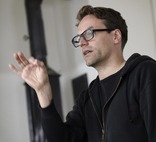
Jan Verwoert
Then on Wednesday night at UBC, at another packed lecture hall, the Berlin art critic/writer Verwoert also argued against prevailing constructs but in the case of visual art it’s the great, grinding academic/analytical machine that surrounds art production.
The rational, scientific view has partially failed us, Verwoert told the audience. The real power is not in representation but in the artist’s success in channeling the essence of the work. The artist is at the existential threshold between spaces, wiring some of those energies together, creating an energy circuit that holds an unquantifiable power. |
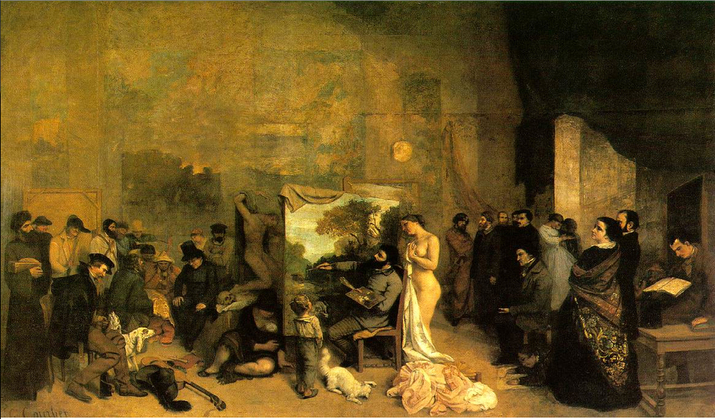
He gives the example of Gustav Corbet’s The Painter’s Studio (1855, above), in which the artist is at work on the threshold between the poor population he relates to, and his privileged patrons who provide his livelihood. The scene raises more questions than answers, with the only conclusion being that the discomfort of those two spaces in one painting creates enduring energy.
“Bearing witness goes beyond making meaning,” he says in his essay, You Make Me Feel Mighty Real. “It’s an avowal of that which may be inexpressible or even impossible to share when what one feels is also felt by the other. Beyond meaning lies feeling. And feeling someone feel what you feel makes all the difference.”
“Bearing witness goes beyond making meaning,” he says in his essay, You Make Me Feel Mighty Real. “It’s an avowal of that which may be inexpressible or even impossible to share when what one feels is also felt by the other. Beyond meaning lies feeling. And feeling someone feel what you feel makes all the difference.”
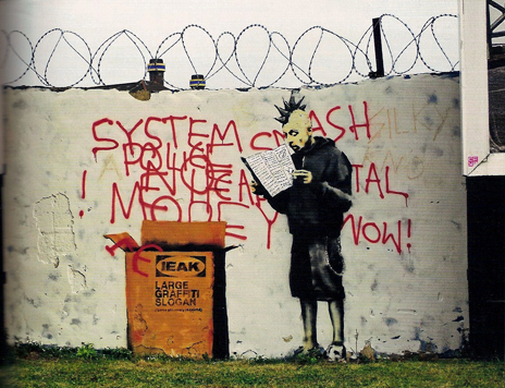
It’s a risky business, thumbing one’s nose at the rational or economic power forces that shape the prevailing structures, or refusing to take a side in a binary view of the world. But assuming the position of witness carries the possibility of new understandings, new discourse, whether the witnessing is expressed in the written word or visually.
This power of the irresolvable, the inconclusive non-statement can be seen in this work (left) by graffiti legend Banksy: Why does the graffiti punk appear to be looking for instruction from a banal global giant? Is Bansky with the anarchist or against him? The power in this work comes from the position of the artist, at the counter between spaces that each contain their own energy, acting as a transference agent, neither healer nor romantic transgressor.
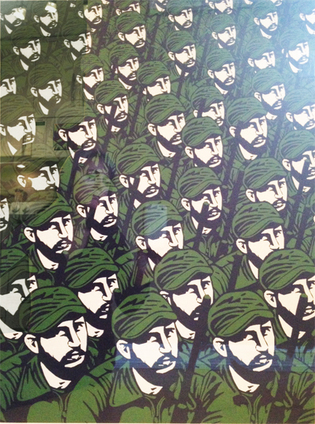
That same irresolvable power is there in this image of a contemporary silkscreen artwork from an unknown Havana artist (right), Cuba PostCastro, circa 2008. The energy lies in the fact that it’s unclear whether the work is an assurance or a warning. The power is in both the formal elements — the geometry, colour and media that composes the image — as well as the history of political art posters, and the artist as witness, at the counter between political and art spaces. It is a powerful art object with no conclusion, no punchline.
At the very least, the irresolvable is awkward. At most, mystical or even magical.
At the very least, the irresolvable is awkward. At most, mystical or even magical.
Fisk and Verwoert would probably agree that if everyone’s slightly uncomfortable in the unknowing, you’re probably onto something.
Recent Comments