
Not a huge leap, as making something out of nothing was already my preferred activity within my own four walls, for hours at a time.
I scored stuff around the house and started fabricating, often without too much of a game plan. I recall a lot of painted papier-mache figurines made of plastic dishwashing liquid bottles, sock puppets from what may or may not have been orphan socks. This is around the first time I heard ‘crepe’ refer to fabric, and not just to ‘paper’, as in, “That was my good black crepe!”
Makers might dream of spacious studios or top-quality materials and tools to develop their concepts through doing, but a lack of all that won’t keep the making from happening. In fact, restricted space and resources can lead to innovation, necessity being the mother of invention and all that.
I was reminded of this during the Eastside Culture Crawl back in November, while visiting Arnt Arntzen‘s steampunky workshop in Strathcona, a must-see stop for any passionate maker. Just a few weeks earlier, Arnt and artist-spouse Valerie Arntzen had just returned from six months in a small pied-a-terre in Amsterdam’s city centre, so surely he wouldn’t have a lot of new examples of his signature reclaimed-wood and metal furniture to show.
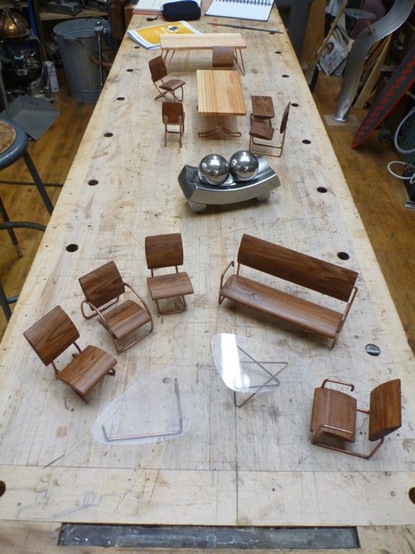
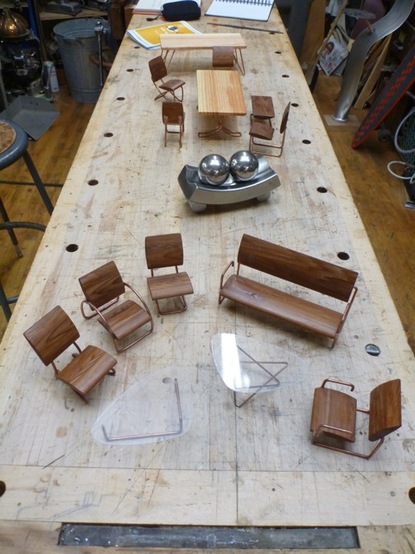
Yet there it was: a collection of what this famously humble industrial designer calls models for future furniture, created out of whatever he found around the city and a Leatherman pocket-sized multi-tool. They may have been modest macquettes to him, but to me they are exquisite, concrete proof that you can’t keep a good maker down. Six months away from his workshop may have been hard for this hard-worker but the restriction also pushed him in another new direction, and the writing was on the walls: paintings that combine his passion for industrial design with pattern and abstraction.
Random sample of innovation with scant art materials and no tools but a lot of heart:
Recent Comments