
As of this writing, those living or working on 500 properties just 60 kilometres away have been ordered to seek dry land. Those on another 1,000 properties are being told to be ready for word to flee the “slow-moving tsunami” from another flooded river south of the border. This is on the heels of a disaster in the same area four years ago due to an atmospheric river that was “about 60 per cent more likely to happen due to climate change.”
Like the waterlogged lands, this news is too much to absorb. “Atmospheric river” — an intense, narrow plume of water vapour that can transport a greater flux of water than the world’s largest river, the Amazon — didn’t exist as a term before the ’90s, never mind be associated with “climate change.” (That’s one of those banned words in the current US Administration’s Energy Department.)
It’s impossible to ignore these several-thousand-kilometres-long plumes, even outside the flood-risk zones. The rain pelts my windows as I tap away on my laptop. It bounces off and pools up all horizontal surfaces. It seeps through the studio skylight no matter how many times the maintenance guy caulks up the seams. And in this watery part of the world we’re in it for the long haul.
Like the waterlogged lands, this news is too much to absorb. “Atmospheric river” — an intense, narrow plume of water vapour that can transport a greater flux of water than the world’s largest river, the Amazon — didn’t exist as a term before the ’90s, never mind be associated with “climate change.” (That’s one of those banned words in the current US Administration’s Energy Department.)
It’s impossible to ignore these several-thousand-kilometres-long plumes, even outside the flood-risk zones. The rain pelts my windows as I tap away on my laptop. It bounces off and pools up all horizontal surfaces. It seeps through the studio skylight no matter how many times the maintenance guy caulks up the seams. And in this watery part of the world we’re in it for the long haul.
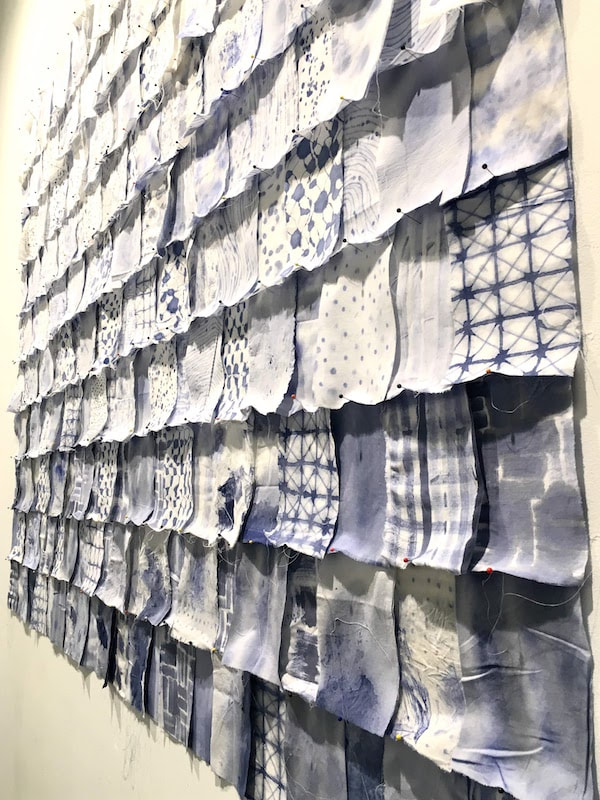
Water always finds its way and in this soggy space that includes artwork, sometimes even intentionally. Drip By Drip was conceived with water on the brain. I started by mixing up an acrylic paint wash of just the blueish Payne’s Grey to dye various found linens in spontaneous patterns. Later I ripped those pieces to expose the frays of warp and weft, then combined these uniform swatches into new patterns.
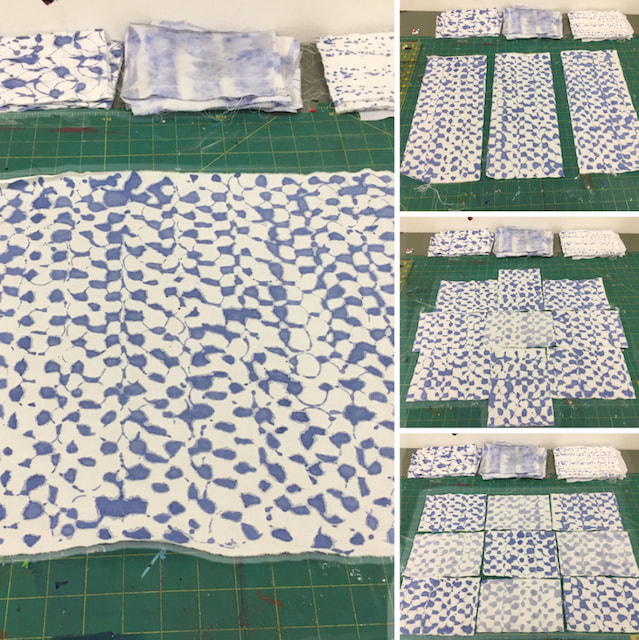
I tacked a few of these squares on the wall in a row using a single sewing pin for each one, then added lapping rows above to cover each pin that in turn scalloped the bottom edge. This lapping, staggered construction was likely borne from the muscle memory of hand-nailing cedar shingles on all sides of a Gulf Island cabin one parched summer because using the generator risked sparking a ground fire. That lengthy, repetitive work in the hot sun opened up time to notice how the straight, grooved woodgrain was easy to split and nail, and to reflect on how any future repairs would only require replacing a shingle or two. I thought about how that straight grain and flanged edges would slough off the much-needed rain and how it would repel water even better if this was the oil-rich old-growth red cedar used for thousands of years by the Coast Salish peoples in this region to build shed-roof plank lelum̓ (houses).
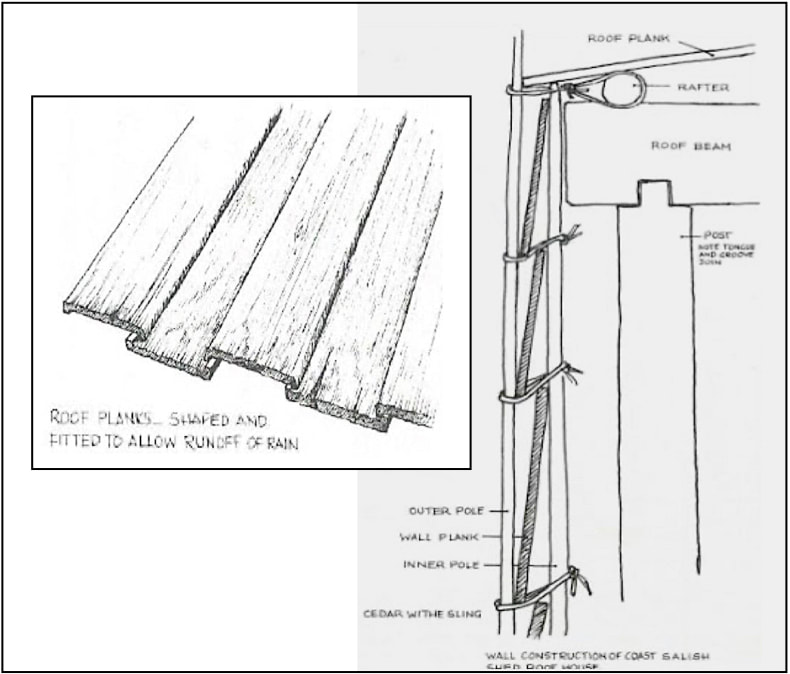
Sketches from Architecture of the Salish Sea Tribes of the Pacific Northwest Shed Roof Plank Houses by Christina Wallace (2017) and Cedar by Hilary Stewart (1984)
I still think a lot about how that long history of best construction practices seen in some of the largest lelum̓ in North America before European contact might be used today, and the hubris in trying to beat back the forces of nature through short-term fixes or just pretend it’s all a green energy scam.
Drip By Drip has unlimited growth potential. It can be seen as an expanding painting practice or an artifact of the right-to-dye socials that went into making this frilly field of fibre. I see it as an ethereal shingled barrier in the futile gesture of trying to hold back the next climate calamity, pretty and pretty disturbing.
Drip By Drip has unlimited growth potential. It can be seen as an expanding painting practice or an artifact of the right-to-dye socials that went into making this frilly field of fibre. I see it as an ethereal shingled barrier in the futile gesture of trying to hold back the next climate calamity, pretty and pretty disturbing.
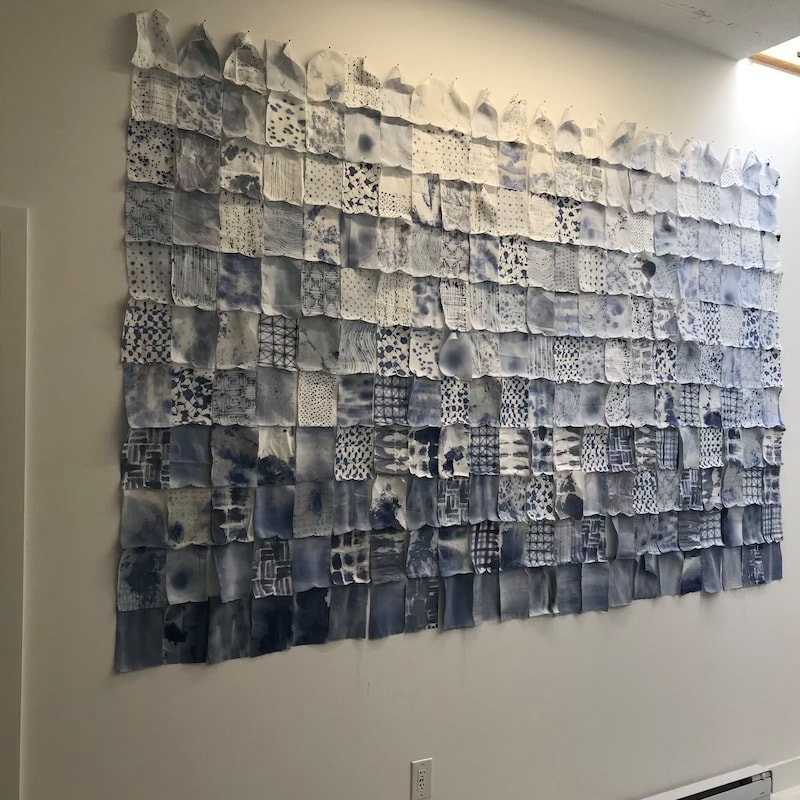
“Drip By Drip”: An ever-growing ombré shingling of dyed found linens and sewing pins (Carlyn Yandle)
Recent Comments