 Carlyn Yandle photo
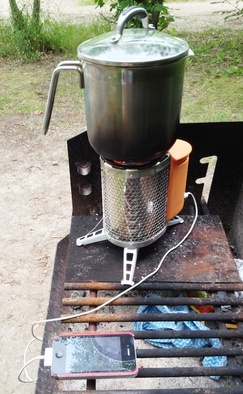
We were a bit of a spectacle, using survivalist technology outside our tent wedged between the humming, air-conditioned RVs,
but we were aching to use our car-camping trip to finally test the BioLite.
And it was good. (See 26-second YouTube review, below.)
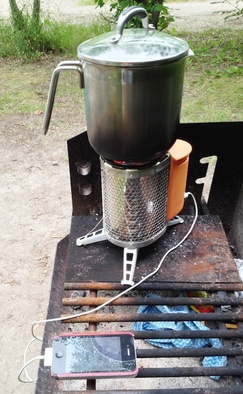
The Sputnik-esque stove converts the energy of any post-disaster carbon-based material — paper, leaves, cardboard, grass, wood shards — into a USB-port power source while boiling water in minutes. Yes, you can have your coffee and call home too, thanks to an ingenious copper conductor-fan system that kicks in when heated and then turbo-charges the tiny fire into a flame as good as if you’re cooking with gas.
The brilliance of this design was not lost on residents of Lower Manhattan who were plunged into cold, damp darkness for days after Hurricane Sandy struck in October 2012.
The young Brooklyn inventors rushed to the rescue with stoves for stranded people who needed a hot drink, social interaction, a way to call family. Emergency services didn’t take too kindly to open fires during the chaos and so the BioLites were banned.
We first spotted the gizmo a month after the area was ravaged, in a New York Times article and made it our Christmas present. Good design endures; now Mountain Equipment Co-op carries it. |
|
 Carlyn Yandle photo
And bad design disappears, or makes the
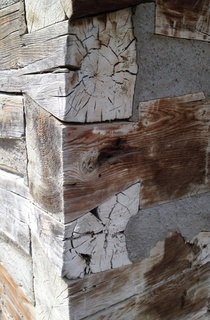
bad design lists. That’s why you don’t see lawn darts anymore. But old, ingenious design isn’t always readily apparent until you really feel it, like the moment we walked into a century-old log cabin and suddenly forgot about the blistering South Saskatchewan heat. Thick walls of almost petrified dovetailed wood and mortar were doing the same trick as energy-squandering air conditioners back at the campsite, except without the drone that was keeping us awake at night.
The rough-hewn angled dovetail joinery, used in various forms in traditional building around the world, succeeds in all aspects of good design. This settler cabin used local, renewable materials, and simple tools and easily-learned methods. The undeniable beauty of those checked cross-sections of silvered lumber, enhanced by age and the elements, is made possible through the collective creative process.
 Carlyn Yandle photo
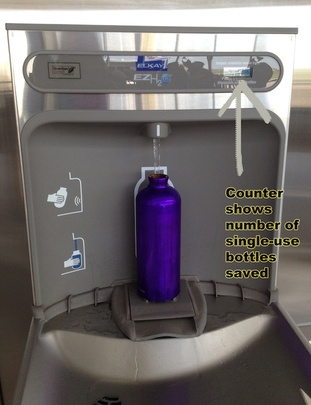
Good design answers a need. And during a heatwave, that need is drinking water. We spent much of our trip looking for a place to fill up our water bottles but it seems that in the rural areas at least, most people still buy the 48-pack of single-use water bottles at the ubiquitous Co-op stores. There oughta be a law to provide ample drinking water in public areas, but I digress.
This beauty (right) in the Saskatoon airport departure lounge does the trick. A motion sensor triggers the water to flow while a counter shows how many plastic bottles were not used in the process.
 Carlyn Yandle photo
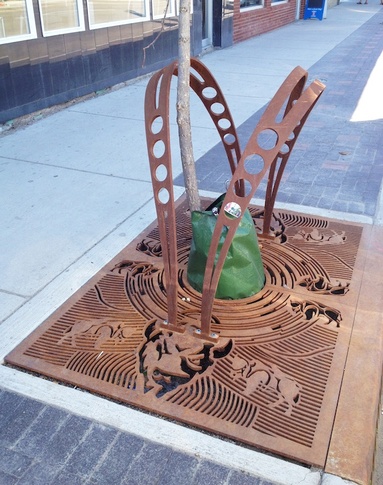
At least the young trees were getting hydrated; in Moose Jaw, a bagged water system seemed to be winning the war against the elements. The surrounding corten steel framework serves as a rain-friendly grill featuring historically significant images of bison/buffalo, trunk protection as the tree grows, and bike lock-up. What’s not to love?
 Carlyn Yandle photo
The one
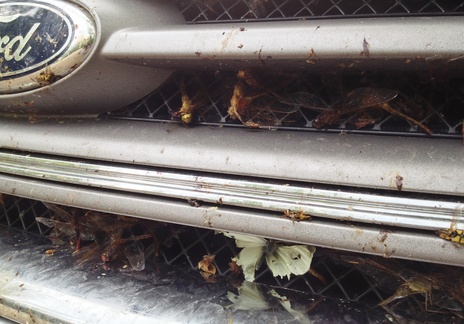
deadly design that haunts me still is the private automobile, a lethal projectile from the point of view of the native large grasshoppers, butterflies and dragonflies (and at least one starling and one small rodent). We tried to avoid looking at the critter mash on the grill at the end of each day but we have their blood on our hands. Their little corpses are reminders that the car is not designed with nature in mind. Next time, bike camping, where RVs fear to tread.

Recent Comments