


It is the convergence of my love of patterns of circles within circles and my growing understanding of the immense value of the Blue Orchard (aka Osmia) Mason Bee. This non-stinging little guy gets up early in the season, collects nectar and spreads pollen at the same time, and is a workhouse in the pollination business compared to the introduced honey bee.
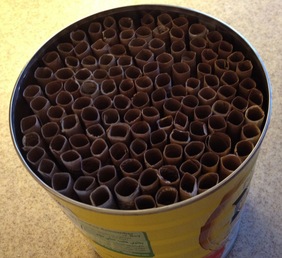
Like most of us, Blue Mason Bees live on their own but are gregarious except their preferred condo complexes are holes in wood. It turns out they also live quite nicely in paper straws that are closed at the back end.
Artists/gardeners/environmentalists/industrial designers have been innovating ways to boost the population of mason bees in response to colony collapse of the honey bee.
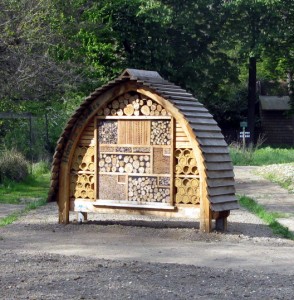
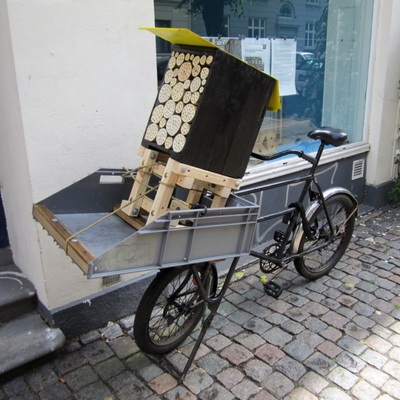
Condo complexes set up in the Jardin du Luxembourg in Paris (above) and in the Paris Botanical Garden provide real inspiration, as do the smaller mobile homes, like the one below in Copenhagen.
 Carlyn Yandle photo
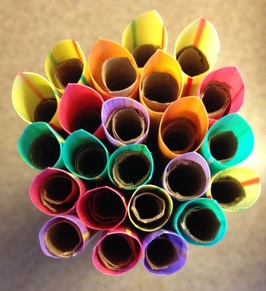
My theory is that bubble tea straws could provide just the right waterproof structure for accommodating all those straws the females pack with cocoons. The straws would be easily removed and the cocoons harvested, cleaned and stored in the fridge for the winter, ready to be set out next spring.
I have no idea whether this will work, but the creative process is one of problem-finding and problem-solving.
 Carlyn Yandle photo
The clusters-within-cluster design of fiber-optic cables (see below) sets the pattern course in a design that moves from pinky-finger width to something on a grand scale that can be seen from a block away by humans.
It’s one of those situations where it will take some doing to get to some knowing.
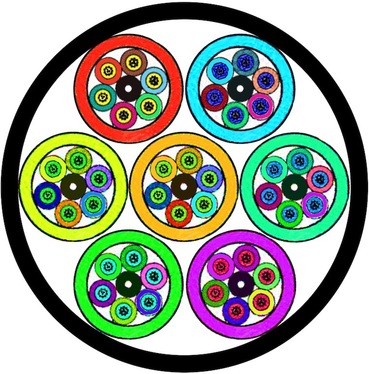 Cross-section of a fiber-optic cable