

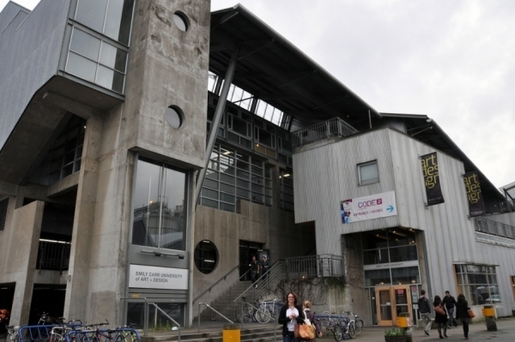
 Photo of ECUAD’s South Building by Stephen Hui/Georgia Straight
But finding a suitable work space in this pricey city is no easy task. Self-(un)employed artists are no match for the slick technology firms and ad agencies that will pay top dollar to set up their cool premises in the port-town-era brick buildings. So we make do, sharing whatever space we can get while keeping an ear open for rumours of where we might be able to jump when the Permit Application billboard springs up in front of our crumbling building.
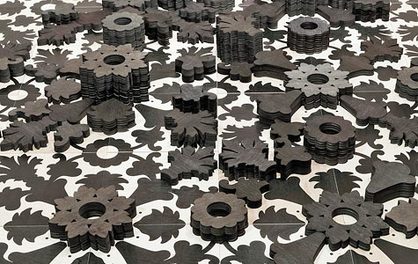 Intriguing shows at the Charles H. Scott Gallery include the current Hyperflat.
Vancouver Sun reporter Daphne Bramham took on the topic this week. In her story, one of the original designers of Granville Island, architect Norm Hotson, said replacing the school with another educational institution would help modernize the zone. Or it could be re-energized as “an incubator space” for “innovators”, he said, or developed into a cultural hub that might include galleries, artist studios, residencies. And he pointed to Paris’s Cité Internationale des Arts as an example.
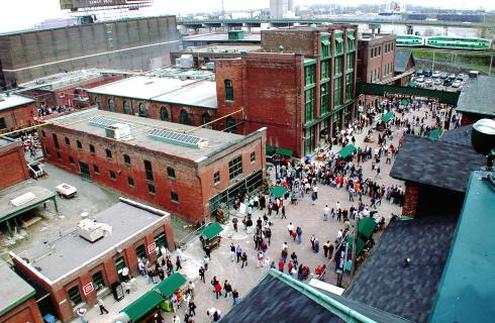 Toronto’s Distillery District was revamped into a cultural hub. (Photo from Artscape website)
Granville Island needs a vibrant injection of new ideas and opportunities and Vancouver desperately needs a cultural hub, a multifunctional space with rental studios and residencies for everyone from painters to industrial designers, techies to musicians, performers to writers.
Yes, it’s a balancing act. Nobody wants the Island to shut as tight as a tomb at night but the neighbours won’t take kindly to the place being mobbed by booze-fueled night-crawlers. Artists and students work all hours, often after a day of slinging Italian coffees or serving Public Market customers. As students we purchase our supplies on the island, we depend on the visitors for our shows and showings. Our work ensures Granville Island is a tourist draw, not a tourist trap, that it is committed to Artisan over Ye Olde, authenticity over Disney.
It may sound like a pipe dream, but Granville Island was part of the inspiration that led the not-for-profit Artscape in Toronto to turn a collection of industrial buildings into a major cultural hub and tourist draw, in a remarkably short time. (See YouTube interview with Tim Jones, president and CEO of CityScape below.)