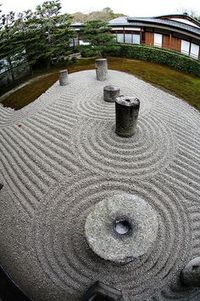
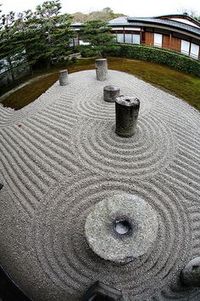
 Zen Garden, Buddhist Temple, Japan
The first time I saw a “dry landscape” Zen garden in one of the hundreds of temples in Kyoto, my brain sort of short-circuited.
This was the mid-’80s, and here was a Zen Buddhist priest meticulously raking the gravel against a lurid neon backdrop of sudden affluence and an alarming amount of consumer waste, often un-used and in its original packaging.
Now, of course, we get it. We have been seduced by the easy acquisition of stuff, then oppressed by all our stuff as the economy contracted (and nearly collapsed in the U.S.) We realized the two-car-garage life was not for us and now we spend a lot of time and angst trying to figure out how to part with our stuff. We have been hoodwinked by marketers who prey on and play up our inadequacies, even inventing a highly lucrative shopping ‘holiday’, Cyber-Monday.
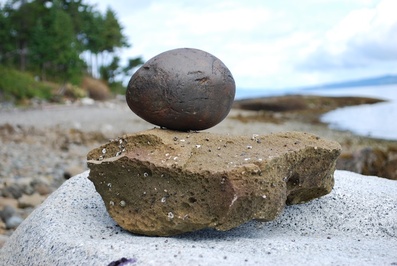 Leah Biggs photo
There’s an entire genre of art that reflects our dis-ease with all the stuff (see 10 visuals
here) and painters have had to re-think their practice (of eking out a living) now that ‘original’ oil paintings sell at Winner’s for $39.99, straight from
Dafen Village, China.
What is emerging is a conversation about what really matters, which inevitably concludes with ‘experiences.’ It would be nice to think this shared revelation is rooted in our own free will, but really, the marketers have shot themselves in the collective foot. A rampant, speculative real estate
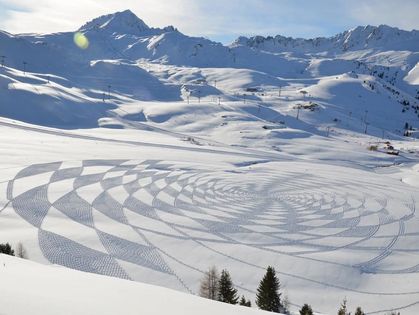 Beck’s fleeting design at a French ski resort uses snowshoes and clotheslines.
market has forced mortgage-choked folks into smaller quarters where there is just no room for more stuff. Car-ownership is being increasingly seen as a hangover from another marketing era and self-expression is no longer synonymous with the home-decor category. Expression is becoming a participatory practice, enhanced by that one burgeoning consumption category — the ubiquitous personal screen and all its accompanying non-object data packages, games and apps. Mobility-marketing promotes an era of impermanence. Photos are as fleeting as the gravel-raking or the daily rice-flower Kolam drawings of South Indian women (see video, at bottom) or the snowshoe-patterns created by Englishman
Simon Beck (left).
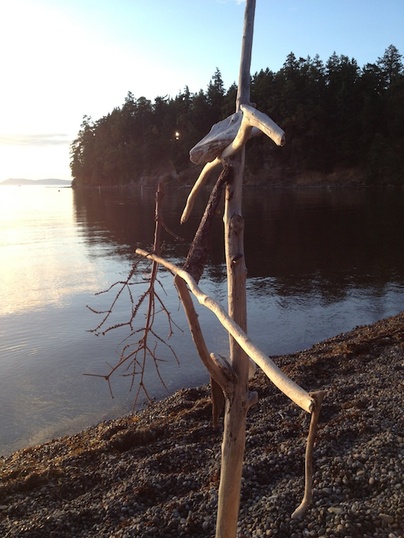 Carlyn Yandle photo
Retail therapy is slowly being replaced by escape therapy. We balance rocks and create
Calder-esque mobiles of driftwood. We take pictures, we post them on our blogs. We have amassed nothing but memories of that mindful, meditative moment of exploring the surface and mass of natural objects. We share them and are inspired by others’ sharing.
Priceless.

Recent Comments