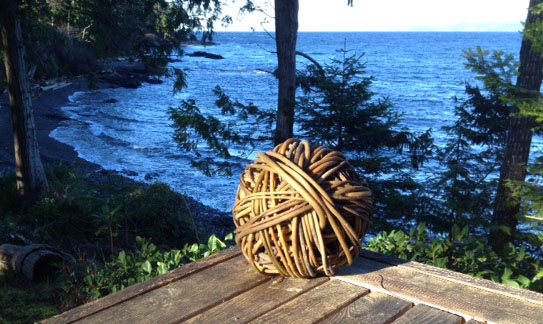
A Christmas Day king tide served up some thick snarls of bull kelp and I seized on an idea.
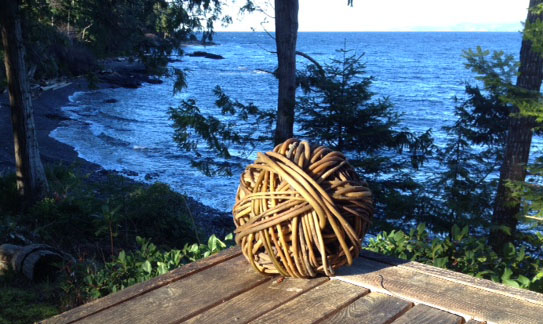 Kelp Skein, in progress. (Carlyn Yandle photo)
Actually, I had no particular idea in mind; only quite a bit of wonder at the quantity of the stuff. After dragging great hunks of it back to the deck, I started to play. I organized the stuff into visual categories, and soon I was winding the tendrils into a skein, and slicing the bulbs into vessels. Some experiments were left in the elements and others brought indoors to desiccate (and hopefully not moulder and go rank).
Will my 20-pound giant ball shrivel up and break apart? Will the vessels turn into leathery cups? Time will tell and failure will be a teacher.
In the meantime, I turn to the research portion of this playing with materials which leads to playing with ideas.
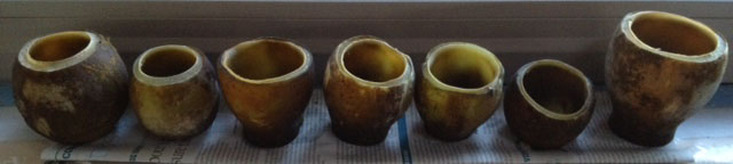
Material test #2: Drying bulbs on a windowsill (Carlyn Yandle photo)
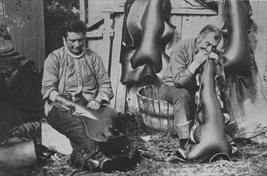 Kelp bags helped preserve harvests of shorebirds.
No surprise this high-tensile, miraculously durable, bouncy stuff has had many practical uses since ancient times.
The first nations of New Zealand called it Rimurapa, and cut into the honey-comb-like walls of the blades to create bags — Poha — to preserve and cook their harvests of muttonbird, an oily shorebird. Or they cut slits in the bags, filled them with shellfish, starfish and abalone, then tossed them in the water to seed coastal areas. Or they attached two inflated pohas and used them as water-wings in strong currents. Or lined woven reed hulls to make super-buoyant Zodiac-type vessels. The first nations in these parts transported oolichan oil.
That’s all before listing all the nutritional attributes, and there was plenty of play in that bull kelp too. The high concentration of alginate makes the material a natural rubber ball.
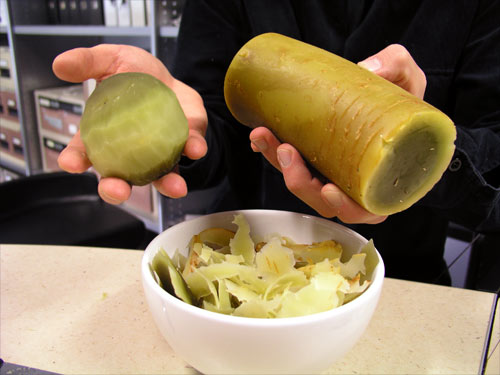
A high concentration of the chemical alginate creates elasticity — perfect for a ball.
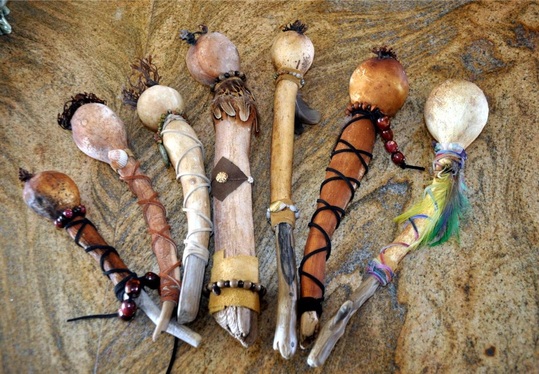 California maker Geri Swanson’s kelp rattles are part of her nature-crafty product line.
If you image-search “use for kelp” you’re hit with a barrage of ideas for thick rings of pickle recipes and a lot of crafty ways with kelp.
Among the fascinating findings are the Seattle area sound performance artist Suzie Kozawa, who makes wind instruments from bull kelp; and Everett, Washington fiber artist Jan Hopkins who combines bull kelp with sturgeon skin and other materials in her conceptual vessels.
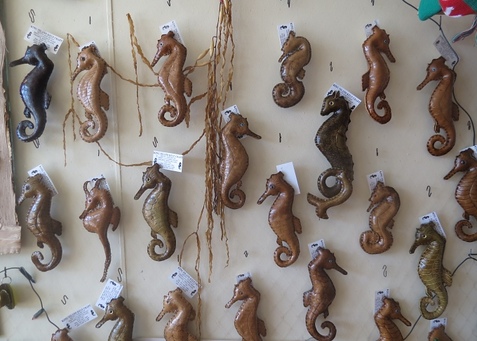
When a craft belies its materials the inherent beauty of that material is lost.
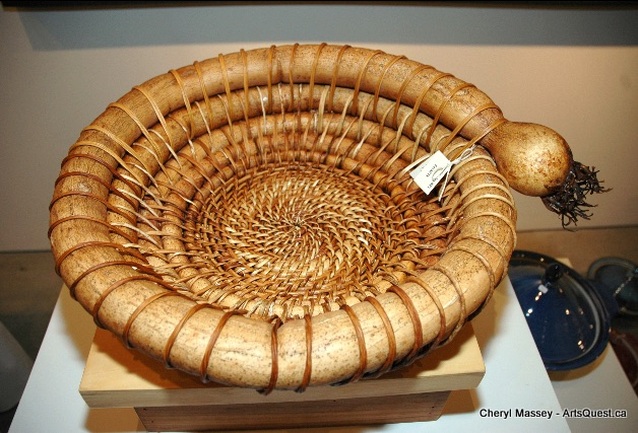
Whistler, BC maker Cheryl Massey celebrates the reducing diameter of the entire length of one bull kelp stem.
But the beauty of the google-search is finding what you’re not looking for, the unintended learning. That happened when I came across American artist/designer/maker Scott Constable and his manifesto-in-the-making of
‘exuberant frugality’ (fine video in that link) that defines what he calls Deep Craft
, based on the principles of deep ecology. Like Constable, I am intrigued by the inherent qualities of bull kelp and am still playing with how to make the most of those characteristics. He is thinking about bronze-casting the bulb and thick stem portions as furniture legs. I will stick to the meditative motions that will grow the kelp skein while keeping me thinking.


Recent Comments