Coming up with new ideas is not without its hazards. The world-renowned
Noma restaurant is a case in point. Chef-patron Rene Redzepi uses what grows in the area, innovating astounding food creations famously foraged from the local land and sea. Sometimes the magic works; sometimes it
doesn’t. He’s even admitted to his own spontaneous bowel reactions to his experiments.
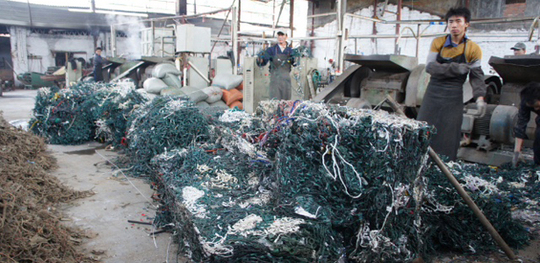 Mountains of Christmas lights headed for the grinder in Shijiao, China (Atlantic Magazine)
One outfit in the southern Chinese town of Shijiao has innovated a low-tech method for squeezing a livelihood out of the great bulk of broken Christmas lights. Making use of the empty shipping containers returning to the global export hub and North Americans’ addiction to buying cheap throwaways, the strings are thrown into a grinder, then shovelled into a water bath that separates the heavier metal wire fragments from the plastic insulator bits. The metals are eventually separated into reusable copper and other metals, and the plastic is used in slipper soles. (Check out the fascinating
video.)
Granted, there are problems, like the possibility of lead in the plastic that ends up cozying up to the soles of feet and the spewing pollution from copper processing.
That necessity to make a living is one mother of invention, a prime example of the hard birth of a global leader in innovation.
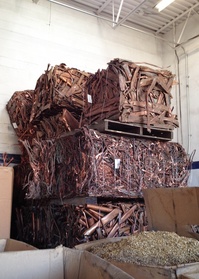 Baled copper. Carlyn Yandle photo
Considering the glut of stuff and our continued rampant consumerism, it’s becoming unconscionable to me to use materials that are not either post-market or readily re-usable. That’s easy to face down in the making of sculptural objects. I find inspiration through foraging in my own environment, where culturally-weighty artifacts from spider-webby doilies to crushed copper play with concept.
But I’m stymied when it comes to painting. I love the exploration but can’t stand the materials. I rely on petroleum-based paints and resins, first-use softwood stretchers, brushes and canvasses. Acrylic paints allow me to do the layering I can’t achieve in oils, creating that fine line between the handmade and digital.
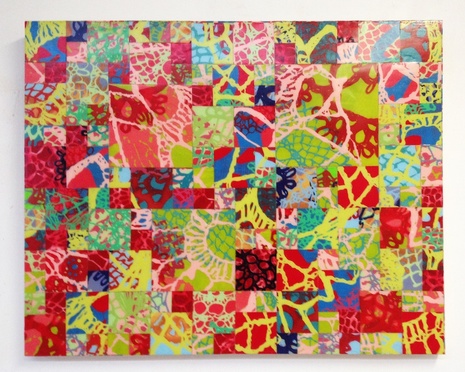 Untitled, 2013, Distract series, acrylic on canvas, 24″ x 30″ on panel.
I feel it all coming to a head: Am I willing to lay down the paintbrush to reduce my own carbon footprint? Not quite.
But I am taking a few baby steps. I’ve been experimenting with composing larger paintings out of my painting studies, to incorporate the patterns of both the painted surface and the piecing, not unlike a quilt made up of well-chosen materials that have outlived their original purpose.
It may just be that necessity to reduce my consumption that pushes me into innovating in painting. Like other innovations, there will be failures and disasters. Somewhere in there is a new way to approach painting.

Recent Comments